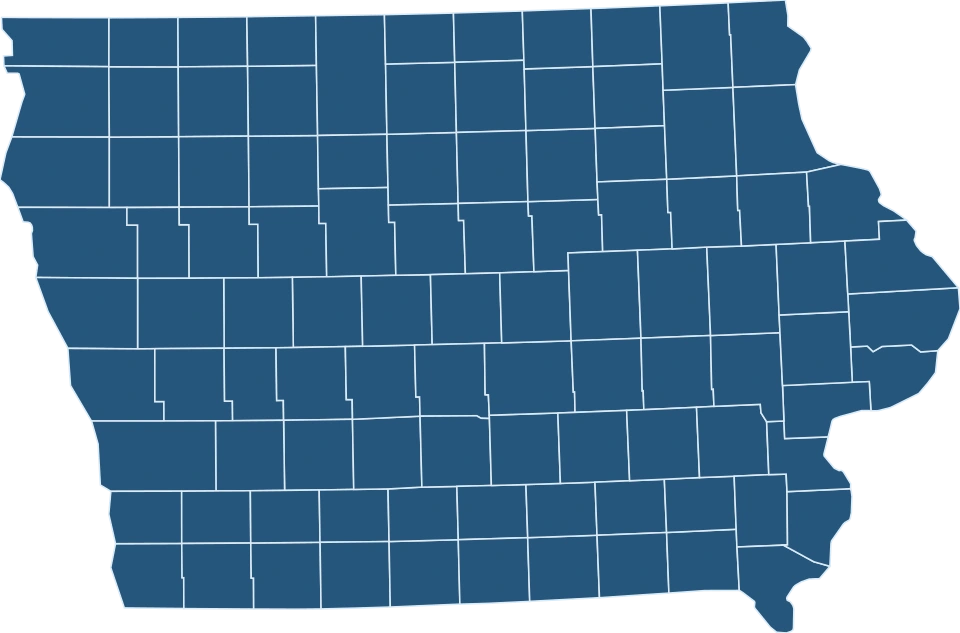
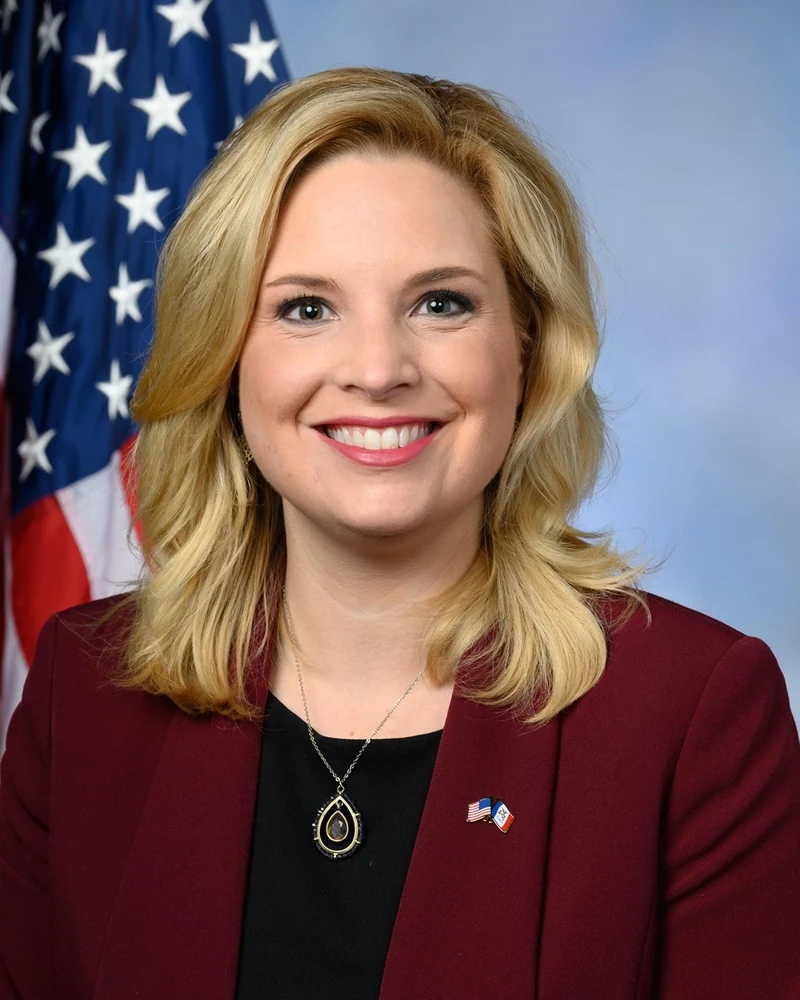
Three-term U.S. representative and former Iowa state legislator who won the Republican nomination for Iowa’s open U.S. Senate seat in 2026. Before elected office, Hinson worked as a television journalist.
Office of Congresswoman Ashley Hinson / U.S. House of Representatives
U.S. Senate race · public polling · September 24–28, 2026
Fox News likely-voter poll: Turek 49%, Hinson 47%; two-point gap is within reported sampling uncertainty
What the poll reports: Fox News reports Democrat Josh Turek at 49% and Republican Ashley Hinson at 47% among Iowa likely voters. Among all registered voters in the survey, Turek is at 50% and Hinson at 46%.
Methodology: The bipartisan Fox News polling team — Beacon Research (D) and Shaw & Company Research (R) — interviewed 1,204 Iowa registered voters Sept. 24–28, including a 1,008-person likely-voter subsample. Interviews used live telephone calls to landlines and cellphones plus online responses after text invitations. Fox reports a ±2.5-point margin of sampling error for registered voters and ±3.0 points for likely voters.
How to read it: The two-point Turek–Hinson difference among likely voters is smaller than the pollster-reported ±3.0-point likely-voter margin of error. That does not prove an exact tie; it means sampling uncertainty is large enough that IA Fact Check does not treat the numerical edge as a statistically clear lead. This is one survey snapshot, not an election result or forecast.
U.S. Senate race · campaign ad fact-check / Epstein files · October 1, 2026
WinSenate ad says Hinson kept Epstein files secret; record supports some criticism but omits her later disclosure vote
What the ad says: WinSenate, a Democratic super PAC, launched a $3 million television campaign saying Ashley Hinson voted to keep Epstein-related records buried, skipped later Epstein-related votes and accepted campaign money from donors whose names appear in released Epstein-related records. WHO 13 reported October 1 that Hinson’s campaign disputed the ad and emphasized her later vote for the Epstein Files Transparency Act.
What the voting record shows: The underlying record is mixed. Hinson did not sign the discharge petition that forced the Epstein Files Transparency Act to the House floor. Official House Appropriations vote packets previously reviewed by IA Fact Check also show her absent from multiple September 2025 Epstein-related amendment votes, while present for final motions to report the underlying appropriations bills. But Hinson later voted Aye when the Epstein Files Transparency Act passed the House 427–1 on November 18, 2025. Iowa Capital Dispatch likewise reported that she supported release while backing the Trump administration’s approach before the forced floor vote.
Donor-context limit: The donor language requires separate caution. IA Fact Check previously documented nearly $90,000 in contributions across Hinson-linked federal campaign/PAC committees from several donors whose names also appear in released Epstein-related records. A person’s name appearing in those records does not itself establish criminal conduct, an Epstein business relationship, knowledge of abuse or wrongdoing, and the contribution record does not establish that donations caused any Hinson vote or absence.
IA Fact Check assessment:Partly supported but materially incomplete. The ad has a factual basis for criticizing Hinson’s earlier opposition to forcing a House vote and for pointing to several later Epstein-related committee absences. It overstates the overall record when “kept the files buried” is read as a complete description, because Hinson ultimately voted for the disclosure law. The donor references are documented as contribution/name-overlap facts, not proof of misconduct or quid pro quo.
Scope: Campaign-ad language is evaluated against the voting, petition and contribution records already documented on this site. IA Fact Check does not infer why Hinson missed a vote, why a donor contributed, criminal conduct from a name appearing in released Epstein-related records, or a quid pro quo absent evidence.
U.S. Senate race · public polling · September 28–29, 2026
Quantus likely-voter poll: Hinson 47.1%, Turek 45.8%; gap is within reported sampling uncertainty
What the poll reports: Quantus Insights reports Republican Ashley Hinson at 47.1%, Democrat Josh Turek at 45.8%, Libertarian Thomas Laehn at 1.7%, and 5.4% undecided in its initial Iowa U.S. Senate ballot test. The 1.3-point Hinson–Turek difference is smaller than the pollster's reported full-study margin of error, so IA Fact Check does not treat the numerical edge as a statistically clear lead.
Methodology: Quantus says it completed 738 interviews through SMS invitations to mobile phones on Sept. 28–29. Its ballot analysis excluded 24 respondents who said they would not vote, leaving 714 voters, and results were weighted to Iowa likely-electorate benchmarks. The pollster reports a ±3.8-point full-study margin of error at the 95% confidence level and cautions that subgroup uncertainty is larger.
Other ballot tests: Quantus reports Hinson 48.5% to Turek 46.6% after allocating initially undecided voters who expressed a lean, with Laehn at 1.7% and 3.2% still undecided. A separate two-major-candidate test reports Hinson 48.9% to Turek 46.7%, with 4.4% unsure. None of those differences is larger than the reported full-study margin of error.
How to read it: This is one survey snapshot, not an election result or forecast. Differences from other public polls can reflect field dates, likely-voter screens, sampling, weighting, question wording and survey mode. IA Fact Check records the poll alongside other public polling without ranking the candidates or predicting the election.
U.S. Senate race · cancer / rural health policy follow-up · September 25, 2026
Hinson highlights clinical-trial access, rural cancer care and tobacco-duty research proposal
Clinical-trial access: Iowa Capital Dispatch reported September 25 that Ashley Hinson, at an American Cancer Society Cancer Action Network event in Urbandale, highlighted her support for the Clinical Trial Modernization Act. The report says the bipartisan proposal would create grants for outreach, education and recruitment aimed at underrepresented populations, including rural patients. Hinson described the measure as clarifying participation rules for clinical studies. The House bill remains a legislative proposal rather than enacted law.
Rural-care funding position: Hinson also defended the Rural Health Transformation Program as a funding stream she was proud to support, saying targeted rural funding can help facilities continue providing cancer care closer to patients. IA Fact Check records that as her policy argument. It does not treat the statement as proof that the program fully offsets other federal health-policy effects or guarantees that any particular rural hospital will remain open.
Cancer-research trust fund: The same event revisited Hinson’s Cancer Research Trust Fund Act, introduced in August. Her office says the bill would direct an amount equal to 10% of annual federal customs duties collected on imported tobacco and tobacco-substitute products into a cancer-research trust fund, prioritizing pediatric and rare cancers. Hinson said fiscal-year 2025 collections would have produced about $24.3 million under that formula. The bill has been introduced and referred to committee; the estimate is a retrospective application of the proposed formula, not money already appropriated or spent.
Scope: These are documented legislative and campaign-policy positions. IA Fact Check does not infer passage, funding outcomes, hospital solvency, clinical benefit, or election effect from sponsorship or support alone.
U.S. Senate race · House schedule / Iran-war follow-up · September 25, 2026
Hinson says House should return to Washington; declines yes-or-no commitment on another Iran War Powers vote
What changed: Iowa Capital Dispatch reported September 25 that Ashley Hinson said it was a mistake for House leaders to cancel session and that the House should return to Washington to work on fuel-cost relief and ending the Iran war. Hinson said she texted Speaker Mike Johnson to press for the House to return and said Johnson replied that leaders were discussing it.
War Powers follow-up: Asked whether she would support another War Powers vote if the House returned, Hinson did not answer yes or no. She said she reviews each bill before voting, said she does not think the House needs another resolution, and again argued that the president should bring the war to an end.
Record context: Hinson’s September 21 statement had already called for a “successful and immediate end” to the war. Her latest answer adds a more specific view about congressional procedure, but it still does not reverse her September 15 Nay on H. Con. Res. 93 or establish how she would vote on a differently worded future measure. IA Fact Check therefore records the new House-return request and her stated opposition to the need for another House resolution alongside the existing roll-call record.
Scope: The report documents current campaign-policy and congressional-procedure positions. It does not establish that House leaders will reconvene the chamber, infer motive for the recess decision, or convert Hinson’s statement into a future roll-call vote.
U.S. Senate / Ashley Hinson record · Medicaid / community health centers · September 23, 2026
Crescent CEO says Medicaid changes could cost Dubuque health center more than $1 million; Hinson team declined post-roundtable interview
What KCRG reported: KCRG reported that Ashley Hinson participated in a September 23 roundtable at Crescent Community Health Center in Dubuque. Crescent CEO Chad Wolbers said about 60% of the center’s patients rely on Medicaid and reiterated concern that changes associated with the enacted reconciliation law Hinson supported could cost the center more than $1 million in funding.
Roundtable and interview context: KCRG reported that Hinson discussed community-health-center access and new legislation during the roundtable but did not address Crescent’s potential Medicaid funding losses there. After the event, KCRG asked Hinson’s team for an interview about those Medicaid concerns; the team declined the request. A declined interview request does not establish why the campaign chose not to participate and is recorded only as part of the outlet’s reporting.
What the record does and does not establish: The more-than-$1-million figure is an attributed estimate from Crescent’s CEO, not a finalized government determination of the center’s eventual loss. Actual effects depend on implementation, enrollment, reimbursement and other policy factors. IA Fact Check therefore records the provider estimate separately from the established fact that Hinson supported the enacted reconciliation law and from broader campaign characterizations of the law.
Record note: This update preserves the distinction between an independently reported provider estimate, Hinson’s documented vote history already covered elsewhere on this site, and any prediction about the center’s final funding outcome.
U.S. Senate / Ashley Hinson record · health policy · September 23, 2026
Hinson introduces LARC Access Expansion Act aimed at rural and underserved community health centers
What was announced: A September 23 release says Rep. Ashley Hinson introduced the LARC Access Expansion Act with Reps. Nicole Malliotakis and Stephanie Bice. The proposal is aimed at expanding access to long-acting reversible contraceptives such as IUDs and arm implants through eligible community health centers in rural and underserved areas.
Bill mechanics described in the release: The release says eligible centers could receive grants to train at least two full-time providers to provide LARCs, procure and maintain same-day inventory, and participate in a telehealth demonstration grant. It says priority would go to centers serving medically underserved populations, areas with high maternal or infant mortality, and health-care deserts.
Status and limits: This is an introduced legislative proposal, not an enacted program. The reviewed release describes the bill's intended grant structure but does not by itself establish final appropriations, participation levels, utilization, health outcomes or implementation costs. IA Fact Check records the proposal and its stated mechanics without treating projected benefits as achieved results.
Record note: The Iowa Standard item reproduces the congressional-office release; it is used here to document what Hinson announced, not as independent evidence that the proposal will achieve its stated policy goals.
U.S. Senate race · debate schedule · September 23, 2026
Nexstar schedules Hinson–Turek U.S. Senate debate for October 13 at 9 p.m. CT
Official organizer announcement: Nexstar Media Group announced September 23 that Republican nominee Ashley Hinson and Democratic nominee Josh Turek are scheduled to participate in a live Iowa U.S. Senate debate on Tuesday, October 13, from 9 to 10 p.m. CT. The program will originate from WHO 13 in Des Moines, with WHO 13's Amanda Krenz and KCAU's Tim Seaman moderating. Nexstar says the debate will air across participating Iowa-market stations and stream on their digital platforms. The announcement identifies immigration, education, health, agriculture and technology among planned topics.
Scope and limits: This confirms the organizer's date, time, distribution plan and announced topic areas. It does not establish the questions that will ultimately be asked, candidate performance, audience size or an election outcome. IA Fact Check treats the organizer announcement as schedule information, not as a candidate rating or forecast.
Record note: The previously announced Iowa PBS debate remains separately scheduled for October 7 at 7 p.m.; this Nexstar event is the second statewide general-election debate already accepted by both candidates.
U.S. Senate race · public polling · September 17–20, 2026
What the poll reports: Marist reports Democrat Josh Turek at 50% and Republican Ashley Hinson at 42% among Iowa registered voters in its September survey.
Methodology: Marist says it interviewed 1,050 Iowa registered voters Sept. 17–20 using a multi-mode design with live-interviewer phone calls, text and online contacts. The reported margin of error for registered voters is ±4.4 percentage points.
How to read it: This is one survey snapshot, not an election result or forecast. The sample is registered voters rather than a likely-voter screen, and differences from other public polls can reflect field dates, sampling, weighting, mode and turnout assumptions. IA Fact Check records the result alongside other public polling without ranking the candidates or predicting the election.
U.S. Senate race · Iran-war policy position · September 21, 2026
Hinson calls for a “successful and immediate end” to the Iran war after repeated votes against House removal resolutions
New statement: Ashley Hinson’s campaign published a September 21 statement saying the Iran war should be brought to a “successful and immediate end.” The same statement tied the conflict to costs facing Iowans and repeated her proposals for a temporary gas-tax suspension, a diesel-export pause, broader E15 availability, a biodiesel tax credit and a diesel-relief program.
Voting-record context: Reuters reported September 21 that Hinson had repeatedly voted against House measures seeking to curb President Trump’s authority to continue the conflict. The most recent official example is House Roll Call 307 on September 15: Hinson voted Nay on H. Con. Res. 93, a War Powers resolution directing removal of U.S. forces from hostilities with Iran unless otherwise authorized.
What changed — and what did not: The September 21 statement adds an explicit call for the war to end promptly. It does not by itself reverse the earlier roll-call votes, specify support for a particular War Powers resolution, or establish how Hinson would vote on a future authorization or removal measure. IA Fact Check therefore records the new policy statement alongside, rather than in place of, the prior voting record.
Scope: This is a documented campaign-policy position and voting-record comparison. It is not a candidate score, endorsement, ranking or election forecast, and it does not infer motives for the timing of the statement.
U.S. Senate race · fuel-cost policy follow-up · September 21, 2026
Hinson and Turek both call for temporary federal gas-tax suspension and diesel-export pause
What changed: Radio Iowa reported September 21 that both major-party candidates for Iowa’s open U.S. Senate seat now support temporarily suspending the federal gas tax and pausing U.S. diesel exports. Josh Turek had announced those two steps September 16; Ashley Hinson announced support for the same two steps September 21.
Additional proposals: Radio Iowa reports Turek has also called for using the Strategic Petroleum Reserve to increase fuel supply. Hinson called for a diesel-relief program aimed at farmers and truckers and for reinstating a $1-per-gallon biodiesel production tax credit that Radio Iowa says expired in 2024.
Current price context: Radio Iowa reported AAA’s Iowa diesel average at just over $6.31 per gallon on September 21. The figure is a daily market average, not evidence that any candidate proposal would lower prices by a particular amount.
Federal tax context: Federal Highway Administration guidance lists the federal motor-fuel excise tax at 18.4 cents per gallon for gasoline and 24.4 cents per gallon for primarily diesel special fuel. A tax suspension therefore has a defined statutory tax component, but the reviewed candidate reporting does not establish how much of any tax change would be passed through at retail, how long a suspension would last, or how Highway Trust Fund revenue would be replaced.
Scope and limits: These are campaign policy proposals, not enacted law. The reviewed sources do not provide complete bill text, duration, eligibility details for Hinson’s proposed diesel-relief program, a legal mechanism for a diesel-export pause, or quantified price effects. IA Fact Check therefore records the areas of agreement and the additional proposals without assigning either candidate a score, ranking or election forecast.
What the poll reports: The Trafalgar Group’s September Iowa U.S. Senate survey reports Republican Ashley Hinson at 44.0%, Democrat Josh Turek at 42.1%, Libertarian Thomas Laehn at 3.4% and 10.4% undecided.
Methodology: Trafalgar says the survey was conducted Sept. 16–18 among 1,089 likely general-election voters, with a 5.7% response rate, a reported margin of error of ±2.9 percentage points and 95% confidence.
How to read it: These are survey estimates, not election results or a forecast. The 1.9-point difference between Hinson and Turek is smaller than the poll’s stated overall margin of error. Polls can differ because of sampling, likely-voter screens, weighting and field methods, so this result should be read alongside other public Iowa polling rather than as a guaranteed outcome.
U.S. Senate race · tax-policy claim follow-up · September 19, 2026
Hinson says Turek would end tips and overtime tax cuts; current reporting also records Turek supporting “no tax on tips and overtime”
What happened: Iowa Capital Dispatch reported that Ashley Hinson and U.S. Sen. John Barrasso held a September 19 event at Whiskey River in Ankeny focused on tax changes enacted in 2025. Hinson repeated the claim that Josh Turek would support removing the law’s tax benefits for tips and overtime.
What the same reporting says about Turek: Iowa Capital Dispatch reported that Turek has said he agrees with President Donald Trump that “we should have no tax on tips and overtime,” while criticizing other parts of the broader law, including Medicaid and SNAP changes. On the available record, opposition to other provisions of the law does not by itself establish opposition to these two deductions.
What the tax provisions do: IRS guidance describes temporary deductions for tax years 2025 through 2028. Qualified tips can be deducted up to $25,000, subject to occupation, reporting and income rules. The overtime deduction generally applies to the FLSA overtime premium — the portion above the worker’s regular rate — up to $12,500 for an individual or $25,000 for joint filers, with income phaseouts. The provisions are therefore narrower than a universal exclusion of every dollar of tips or overtime from federal tax.
What remains unresolved: The September 19 reporting does not identify a detailed Turek bill or repeal-and-replace mechanism showing exactly how he would preserve the tips and overtime deductions while changing other provisions of the 2025 law. IA Fact Check therefore records the competing statements without inferring a future vote that has not occurred.
The Des Moines Register reported that Hinson said she shares concerns about AI-related job, identity and privacy risks and favors oversight while also arguing the United States should remain a global leader in AI development. She described the need for action as time-sensitive and cautioned against rules so restrictive that they push development elsewhere.
Record note: These are attributed campaign-policy positions and descriptions of pending proposals, not enacted policy or a candidate evaluation.
Public record and background
Won election to the U.S. House in 2020 and was reelected in 2022 and 2024.
Previously served in the Iowa House of Representatives.
Serves in Congress with an extensive federal roll-call record that is linked directly from this profile.
Won the 2026 Republican U.S. Senate nomination.
Formally accepted Iowa PBS and Nexstar Media invitations for two statewide general-election debates against Josh Turek on July 28, 2026; Iowa PBS scheduled its debate for October 7 at 7 p.m., and Nexstar later scheduled its debate for October 13 from 9 to 10 p.m. CT.
Late-July campaign-finance reporting identified nearly $90,000 in contributions across Hinson-linked federal committees from donors whose names also appear in released Epstein-related records. Appearance in those records does not itself establish wrongdoing; Hinson later voted Aye on H.R. 4405, the Epstein Files Transparency Act, when it passed the House 427–1 on Nov. 18, 2025.
An Aug. 17 congressional-record review counted 196 Hinson absences since 2021: 163 committee votes and 33 House floor votes. Some absences coincided with COVID, and committee votes are not part of the standard floor-roll-call attendance percentage.
House financial disclosures document substantial growth in household assets during Hinson’s time in Congress, but the forms report value ranges rather than exact net worth. The records do not by themselves establish that Hinson used public office to enrich herself.
On Aug. 24, the American Bankers Association and Iowa Bankers Association announced a new Iowa ad praising Hinson’s support for housing, first-time-homebuyer and community-investment legislation. IA Fact Check records the ad as banking-industry advocacy and does not treat its broad affordability/economic-effect claims as independently established outcomes.
Campaign ads, attacks and response media reviewed
U.S. House · H.R. 5334 · Russia/Iran sanctions · September 16, 2026
All four Iowa House members vote Yea as House concurs in Senate amendments to H.R. 5334, 262–159
Official vote: The U.S. House Clerk records Roll Call 308 on September 16 as a 262–159 vote to concur in the Senate amendments to H.R. 5334, the Lindsey O. Graham Sanctioning Russia and Iran Act of 2026. Party totals were 203 Republican Yeas and seven Republican Nays; 58 Democratic Yeas and 152 Democratic Nays; and one Independent Yea, with 12 members not voting.
Iowa votes: The Clerk records Ashley Hinson, Zach Nunn, Mariannette Miller-Meeks and Randy Feenstra all voting Yea.
What the measure does: The Senate-amended package establishes and expands sanctions aimed at Russian officials, financial institutions, energy shipping and sanctions evasion, includes secondary-tariff authority tied to purchases of Russian energy, and extends Iran-related sanctions. The Senate had passed the amended bill 86–11 on August 7. After the House concurrence vote, the measure goes to the President.
Context and limits: This roll call records each member's position on this specific sanctions and tariff package. It does not establish why a member voted that way, does not predict presidential action, and does not by itself establish the measure's eventual economic, diplomatic or security effects.
Hinson “Aisle” ad: rural-veterans bipartisan work is documented; insurer-cost claim needs a narrower reading
What the ad says: Ashley Hinson’s campaign released the general-election ad “Aisle” on September 15. In the campaign transcript, Hinson says she “worked with Democrats to expand mental healthcare for veterans” and “with President Trump to take on big health insurance companies to lower your costs.”
Veterans claim — documented: The Congressional Record shows Hinson speaking in support of H.R. 2441, the Sgt. Ketchum Rural Veterans Mental Health Act, thanking Democratic Iowa Rep. Cindy Axne for introducing it and saying she was proud to join Axne and the Iowa delegation on the bipartisan bill. The enacted text required VA to establish three new Rural Access Network for Growth Enhancement (RANGE) centers and required a GAO study of rural-veteran mental-health resources. It became Public Law 117-21. That record supports the ad’s narrower statement that Hinson worked across party lines on legislation expanding rural-veteran mental-health access.
Health-insurer / cost claim — action documented, outcome not established: On August 5, 2026, Hinson introduced the Health Insurance Transparency for Patients Act. Her congressional office says the bill would require insurers to publish denial, approval, appeal, prior-authorization and decision-time information so consumers can compare plans. That is a documented action aimed at insurer transparency and accountability. The cited campaign and congressional materials, however, do not by themselves establish how much the bill has lowered consumer costs, nor do they identify a specific enacted result from a Hinson–Trump collaboration that can be quantified as lower costs. The campaign’s broader cost-result wording therefore goes beyond what these sources alone establish.
Bottom line: The veterans example has a clear bipartisan legislative record and enacted result. The insurer portion points to a real Hinson proposal, but the ad compresses proposal, collaboration and consumer-cost outcome into one sentence; those are separate factual questions, and a bill’s introduction is not proof that costs have already fallen because of it.
U.S. House · Iran War Powers vote · September 15, 2026 · follow-up September 17
Nunn and Miller-Meeks switch to Yea on H. Con. Res. 93; both say continued Iran combat needs clearer limits or authorization
Official vote: The U.S. House Clerk records Roll Call 307 on September 15 as a 220–204 vote agreeing to H. Con. Res. 93, which directs the President under section 5(c) of the War Powers Resolution to remove U.S. Armed Forces from hostilities with Iran unless otherwise authorized. Zach Nunn and Mariannette Miller-Meeks voted Yea; Ashley Hinson and Randy Feenstra voted Nay.
What changed: Associated Press and Iowa Public Radio reported that Nunn and Miller-Meeks had voted against two earlier similar Iran War Powers resolutions but voted for H. Con. Res. 93. That is a documented change on this specific removal-resolution question, not evidence that either member changed every aspect of their Iran policy.
Nunn explanation: Nunn said that with the negotiating window closed, sustained combat operations require congressional authorization. He also said he would not support another open-ended war and framed the vote around constitutional oversight, while continuing to say Iran should be held accountable.
Miller-Meeks explanation: Miller-Meeks said the mission had to remain focused and limited, that she would not support keeping U.S. troops in an open-ended war, and that the President should present Congress and the public with a plan for how the conflict ends. She also cited Iowans' fuel costs.
Context and limits: AP reported that fuel prices and war casualties are part of the political context surrounding the vote. Those conditions do not establish why every member voted as they did; the explanations above are attributed to Nunn and Miller-Meeks themselves. The Yea vote directs removal from hostilities absent authorization but does not by itself bar every defensive action involving Iran.
Iowa PBS schedules Hinson–Turek U.S. Senate debate for October 7 at 7 p.m.
Official schedule: Iowa PBS announced September 2 that Republican Ashley Hinson and Democrat Josh Turek are scheduled to participate in a live U.S. Senate debate on Wednesday, October 7 at 7 p.m. at the network’s studios in Johnston.
Format and access: Iowa Press moderator Kay Henderson will host and moderate with Iowa political reporters. Iowa PBS says the debate will air live statewide and stream on iowapbs.org and YouTube, and will be held without a live audience.
Record status: This establishes the announced Iowa PBS debate date and format. It does not establish an election outcome or how either candidate will perform. Separate debate invitations or events remain distinct unless their organizers publish confirmed details.
U.S. Senate · affordability policy · September 10, 2026
Hinson does not commit on Trump’s proposed $5,000 adult dividend; says she wants to review the details
What Hinson said: In September 10 reporting from Iowa Capital Dispatch syndicated by Gray Media, Republican U.S. Senate candidate Ashley Hinson said she would not say whether she supports President Donald Trump’s proposed $5,000 payment to adult U.S. citizens until she had reviewed the details. She said her broader focus is relief for working and middle-class families.
What Trump proposed: Reuters reported that Trump said the payment would go to every adult citizen if Republicans retain control of both chambers of Congress after the November election. The initial announcement did not provide a detailed funding or implementation mechanism.
Budget context: The Committee for a Responsible Federal Budget estimates a universal $5,000 adult payment would cost more than $1.2 trillion in 2027. That is an outside budget estimate, not an enacted cost, because the proposal has not been enacted and its eligibility rules could change.
Record status: Hinson’s September 10 remarks are a documented non-commitment pending details, not an endorsement or rejection of the proposal. IA Fact Check records the position as stated and keeps the separate national cost estimate clearly attributed.
Turek supports eliminating Social Security’s taxable-earnings cap; 2026 federal cap is $184,500
What Turek said: At a Sept. 9 event and in follow-up coverage published Sept. 10, Josh Turek said he supports eliminating the income cap on earnings subject to Social Security payroll tax, arguing higher earners should continue paying into the program above the current threshold.
What current law does: The Social Security Administration says the 2026 contribution and benefit base — commonly called the taxable maximum — is $184,500. Wages above that amount are not subject to the 6.2% employee OASDI tax or the matching employer tax, and earnings above the cap also are not counted in the benefit formula.
Hinson campaign position in the same reporting: Ashley Hinson’s campaign said she opposes cutting Social Security benefits and has opposed raising the retirement age. The reviewed reporting did not identify a Hinson proposal to remove the taxable maximum.
What this establishes: This is a concrete policy difference on program financing. It does not by itself establish how a future bill would define taxable earnings, whether benefit formulas would also change for earnings above today’s cap, or the exact long-term solvency effect of a specific legislative proposal.
U.S. Senate · outside-group advertising · September 10, 2026
AFP Action announces a $750,000 pro-Hinson ad buy and presses Turek on Medicare for All and fossil fuels
What is confirmed: Americans for Prosperity Action announced a $750,000 statewide digital and streaming advertising buy supporting Ashley Hinson. The spending described in the release is outside-group advocacy, not Hinson campaign spending.
What the release says about Turek: AFP Action says Josh Turek should answer where he stands on “Medicare for All” and “eliminating fossil fuels.” That wording is a request for positions and political framing; it is not itself evidence that Turek has endorsed either policy.
Healthcare record reviewed: Iowa Capital Dispatch reported in June that Turek advocated a public option / public-private hybrid and said people who wanted private insurance could keep it. That documented position is different from a single-payer Medicare for All plan that replaces private coverage.
Fossil-fuel claim: In the sources reviewed for this update, IA Fact Check did not find a direct Turek statement endorsing elimination of fossil fuels. That does not establish that no such statement exists; it means the outside group’s question should not be converted into a factual assertion about his position without a source.
Assessment:The $750,000 ad buy is documented. The policy characterizations require candidate-specific sourcing. IA Fact Check records the ad campaign while separating the group’s questions from established positions.
Turek’s “842 healthcare entities closed” figure matches a broad DIAL database count, but it is not 842 hospitals or clinics
The claim: At a September 9 campaign event, Josh Turek said that since Ashley Hinson took federal office, as many as 842 “healthcare entities” have closed across Iowa.
Where the number comes from: Iowa Starting Line reported a review of the Iowa Department of Inspections, Appeals, and Licensing health-facilities database that counted 842 entities with closure dates since 2021. The same review counted 468 openings over that period and noted that 41% of currently active entities lacked an initial-license date, which makes opening-versus-closing comparisons incomplete.
What “healthcare entities” includes: The database is broader than hospitals and physician clinics. The reported closure set includes two hospitals, one critical-access hospital, 11 rural health clinics, 46 nursing homes, 28 residential-care facilities, 16 hospices and three ambulatory surgical centers, but it also includes categories such as health-care employment agencies. DIAL specifically says health-care employment agencies are registered, not licensed and that their office locations appear in the Health Facilities Division database.
Why the distinction matters: The 842 figure can describe database entities whose records closed; it should not be translated into “842 hospitals closed,” “842 clinics closed,” or even 842 direct-care locations without filtering the entity types and examining individual status histories. Some database categories represent programs, registrations or business offices rather than a hospital or clinic front door.
IA Fact Check assessment:Supported count; needs context. Turek used the relatively careful phrase “healthcare entities,” and an independent review of the state database reports 842 closures since 2021. The number nevertheless combines very different regulated/registered entity types. The evidence supports a broad database-closure count, not the stronger implication that Iowa lost 842 hospitals or clinics.
What remains open: A fully apples-to-apples net-access measure would require category-by-category review, treatment of relocations/ownership or license changes, and a consistent opening-date baseline. The state database’s incomplete initial-license dates for many active records make a simple 842-minus-468 calculation an imperfect measure of changes in patient access.
Turek / O’Malley claim that Ashley Hinson “voted to cut Social Security” needs a benefits-versus-administration distinction
The claim: At a Sept. 9 Josh Turek campaign event, former Social Security Administration Commissioner Martin O’Malley said Ashley Hinson “has damaged Social Security, she voted to cut it.” The event also cited cuts to the Social Security Administration of as much as $452 million.
What the cited 2024 vote was: Hinson’s campaign did not dispute that she supported the July 2024 House Appropriations Committee bill; it said the proposal reduced staffing funding at Washington and Baltimore SSA offices and did not cut benefit payments or field offices. The House Appropriations Committee says the FY2025 Labor-HHS-Education bill advanced 31-25 on July 10, 2024.
What SSA’s own appropriation history shows: SSA lists FY2024 enacted annual Limitation on Administrative Expenses funding at $14.226978 billion and the FY2025 House Committee level at $13.825776 billion — about $401.2 million lower. The final FY2025 enacted amount was $14.298978 billion, about $72 million above FY2024. Different subcomponents can produce different comparisons, so the specific “as much as $452 million” figure needs the speaker to identify the exact account/baseline being used.
Benefits versus agency operations: The disputed House committee proposal concerned SSA administrative funding, not a statutory reduction in scheduled Social Security benefit formulas. Administrative funding can affect staffing, wait times and service capacity, so describing it as a cut to the agency is supportable; describing the vote simply as a vote to “cut Social Security” can lead listeners to think retirement or disability benefit amounts were cut, which the cited vote did not do.
IA Fact Check assessment:Needs context. Hinson supported a House committee proposal that would have reduced SSA administrative funding relative to FY2024 enacted funding. That is a real agency-budget cut. But the vote did not reduce scheduled Social Security benefits, and the final FY2025 appropriation ultimately increased SSA administrative funding slightly over FY2024. The exact $452 million figure was not reproduced by the total annual LAE comparison in SSA’s own table.
What remains open: IA Fact Check would update the dollar figure if Turek, O’Malley or the endorsing groups provide the exact budget line and baseline underlying the $452 million number.
U.S. Senate · Ashley Hinson · campaign ad audit · September 9, 2026
Hinson’s “Squeezed” ad mixes enacted tax changes with narrower eligibility rules and still-pending health-care bills
What the ad says: Hinson’s new “Squeezed” ad says families face higher prices, that she is working with both parties against large drug and health-insurance companies, that Republicans “eliminated taxes on tips and overtime” and “cut taxes on Social Security,” and that additional affordability work remains.
Tips and overtime:Enacted, but the shorthand is broader than the tax rules. IRS guidance confirms temporary 2025–2028 deductions for qualified tips and qualified overtime. The tip deduction is capped at $25,000 and phases out above specified income thresholds. The overtime deduction generally applies to the FLSA overtime premium — the extra half of time-and-a-half — up to $12,500 for an individual ($25,000 joint), with income phaseouts. The law did not make every dollar of all tips or all overtime universally tax-free.
Social Security:Tax relief for many seniors, not a repeal of Social Security-benefit taxation. The law created a temporary enhanced deduction of up to $6,000 per qualifying senior, subject to income limits. SSA still states that up to 85% of Social Security benefits can be taxable above existing combined-income thresholds. Hinson’s “cut taxes on Social Security” wording is defensible as campaign shorthand for senior tax relief, but it should not be read as eliminating the statutory taxation of Social Security benefits.
Child Tax Credit / Trump Accounts: The 2025 law permanently increased the Child Tax Credit to $2,200 per qualifying child, with inflation indexing after 2025. It also created Trump Accounts and a $1,000 federal pilot contribution for eligible U.S.-citizen children born from 2025 through 2028. Those parts of the ad describe enacted law, although eligibility rules still matter.
Health-care and child-care proposals: Hinson introduced the Health Insurance Transparency for Patients Act, which would require disclosure of claim denials, approvals, appeals and prior-authorization practices, and she co-led the bipartisan Child Care Modernization Act. Both are documented proposals; introduction or cosponsorship is not the same as enacted cost reduction.
IA Fact Check assessment:Mostly supported, with important scope and status context. The ad points to real enacted tax provisions and real bipartisan/pending legislation. Its weakest shorthand is “eliminated taxes on tips and overtime” and “cut taxes on Social Security,” because the enacted deductions are limited by type, amount, income and time period, and Social Security benefits remain taxable under existing thresholds.
What changed: Iowa Capital Dispatch reported September 9 that Iowa Farmers Union participants and several diversified/smaller producers criticized Ashley Hinson’s Save Our Bacon Act, arguing that federal preemption could erase market incentives tied to state animal-production standards. Hinson’s campaign responded that the proposal protects producer and consumer choice. Major Iowa farm groups including the Iowa Pork Producers Association and Iowa Farm Bureau support the legislation, while Josh Turek opposes it.
Food-dollar claim: Iowa Farmers Union president Aaron Lehman said farmers receive “less than 15 cents” of every food dollar. USDA ERS’s revised 2024 Food Dollar model supports that broad all-food statement: farms received 11.8 cents per dollar spent on domestically produced food across grocery stores and restaurants. But USDA reports an 18.5-cent farm share for food-at-home/grocery spending alone. So the under-15-cent statement is supported for the overall food dollar, not for the narrower grocery-only food dollar.
State-law scope: The Dispatch report cites a Harvard Animal Law & Policy Program analysis identifying 13 Iowa laws as potentially affected by H.R. 4673. That is an advocacy/legal analysis of potential preemption, not a court ruling that every listed Iowa law would be invalidated.
IA Fact Check assessment:Fresh policy-context expansion, not a new quid-pro-quo allegation. The current record already documents Hinson’s sponsorship and pork-industry support/contributions. This update adds the September 9 split among Iowa producers and checks the food-dollar statistic without treating either side’s predicted economic effects as established outcomes.
Turek campaign internal poll shows 46%-42% lead; public Emerson poll from overlapping field period showed Hinson 50%-45%
The internal poll: A Global Strategy Group survey conducted for Josh Turek’s campaign reports Turek at 46%, Republican Ashley Hinson at 42%, Libertarian Thomas Laehn at 6%, and 6% undecided. The memo says GSG surveyed 800 likely 2026 Iowa general-election voters by phone and text-to-web Aug. 27-31, with a ±3.5-point margin of error at the 95% confidence level.
Independent context: The public Emerson College Polling/Nexstar survey fielded Aug. 31-Sept. 1 among 750 likely Iowa voters found Hinson at 50% and Turek at 45%, with a ±3.6-point credibility interval. The field periods overlap by one day, but the surveys use different sponsors, samples and methods and should not be treated as directly interchangeable measurements.
IA Fact Check assessment:The 46%-42% figure is accurately reported as a campaign-sponsored internal poll, not proof that Turek is leading the electorate. The simultaneous public Emerson result points the other direction, illustrating why individual polls—especially internal campaign polls—should be read as snapshots within their stated uncertainty rather than election forecasts.
U.S. Senate · Josh Turek / Ashley Hinson · Medicaid claim audit · September 6, 2026
Turek’s “largest Medicaid cut ever” characterization is grounded in a historic federal reduction, but the 110,000-Iowan figure needs narrower sourcing
The claim: Josh Turek said Ashley Hinson “voted for the largest Medicaid cut ever” and “voted to see 110,000 Iowans lose their health care.”
What is supported: Hinson supported the 2025 reconciliation law. KFF, using CBO estimates for the enacted package, calculates roughly $911 billion less federal Medicaid spending over 2025–2034. That is an exceptionally large reduction in federal Medicaid support.
What needs qualification: “Largest ever” is a historical superlative and depends on the comparison method. More importantly, the exact 110,000-Iowan figure is not a current final-law CBO state estimate. Earlier House-version modeling reported by Iowa Public Radio projected about 90,000 fewer Iowa Medicaid enrollees by 2034 and about 69,000 more uninsured Iowans. Enrollment loss and becoming uninsured are not interchangeable measures.
IA Fact Check assessment:Substantially supported on the scale of the Medicaid reduction; the precise 110,000-Iowan “lose their health care” figure is not established by the final-law state estimates reviewed. The site preserves the distinction between federal spending reductions, Medicaid enrollment changes, and total uninsured changes.
U.S. Senate · Ashley Hinson / Josh Turek · war-powers vote claim audit · September 6, 2026
Turek’s “six times” Iran-war vote attack gets the direction right, but the official House record shows seven direct Iran/Lebanon withdrawal resolutions and “voted for the war” is broader than the roll-call question
The claim: At a July 31 affordability roundtable, Josh Turek said Ashley Hinson had “six times voted in favor of this war, and to continue the war in Iran.” Iowa Capital Dispatch reported the statement. A later Heartland Signal account likewise said Hinson voted six times between March and July against measures to limit or end U.S. military involvement in Iran and Lebanon.
What the official House record shows: IA Fact Check identified seven 2026 House roll calls through July 23 on concurrent resolutions directing the president under the War Powers Resolution to remove U.S. forces from hostilities in Iran or Lebanon: rolls 85, 114, 170, 199, 201, 232 and 282. The Clerk’s member tables record Hinson voting Nay on all seven. Five dealt with Iran and two with Lebanon.
What a Nay means: On each of these roll calls, the question was whether to agree to a resolution directing removal of U.S. forces. A Nay therefore opposed that particular withdrawal resolution. It is fair to describe the votes as votes against those congressional efforts to remove forces. But “voted in favor of the war” is political shorthand: the roll calls were not affirmative declarations of war or standalone authorizations for every military action, and a member can oppose a specific War Powers resolution for reasons involving wording, timing, constitutional interpretation or strategy.
The count: The literal “six times” formulation is not inflated. If anything, it is incomplete when all direct Iran/Lebanon War Powers removal resolutions in the March 5–July 23 period are counted: the Clerk shows seven Hinson Nays. The discrepancy likely reflects a different cutoff or selection of resolutions; IA Fact Check does not infer motive from the mismatch.
IA Fact Check assessment:Supported on the underlying voting pattern; exact count understates the seven direct withdrawal-resolution Nays found in the official record, while “voted for the war” is broader political framing. The strongest precise wording is that Hinson voted seven times against these Iran/Lebanon War Powers withdrawal resolutions through July 23.
U.S. Senate · Ashley Hinson · federal spending / inflation · September 6, 2026
Hinson’s “$6 trillion budget” line is grounded in a real 2021 budget fight, but the inflation-causation wording compresses several different things
The current claim: Asked about the proposed $1.5 trillion Defense Department funding package, Ashley Hinson said both parties bear blame for federal spending and added that she had voted against a “$6 trillion budget proposal” from President Joe Biden. Her broader campaign argument has tied that scale of Democratic spending to the record inflation that followed the pandemic.
Her 2021 vote — supported: On August 24, 2021, Hinson voted Nay on House Roll Call 258, H.Res. 601. The resolution passed 220–212 on a party-line vote and provided for adoption of S.Con.Res. 14, Congress’s fiscal-year 2022 budget resolution. So the underlying statement that Hinson opposed the Democratic FY2022 budget framework is supported.
What “$6 trillion” means — needs precision: President Biden’s separate FY2022 budget request, released May 28, 2021, was widely described as roughly a $6 trillion annual budget proposal. The House vote Hinson cast was not a direct up-or-down vote on every line of that presidential request; H.Res. 601 provided for adoption of the congressional budget resolution, which also contained reconciliation instructions that contemporary coverage commonly described as opening the way for a roughly $3.5 trillion package. IA Fact Check therefore treats “I voted against a $6 trillion Biden budget” as understandable political shorthand, not an exact description of the House roll-call vehicle.
Inflation causation — overstated if assigned to that one vote/proposal: CBO’s later review says inflation rose in 2021 because of both supply-side disruptions and heightened demand, with pandemic conditions and policies assisting firms and consumers contributing to those forces. CBO also found expansionary fiscal policy added to inflationary pressures, especially when supply was constrained. That supports saying federal fiscal policy was one contributor. It does not establish that the budget proposal Hinson voted against — which was not itself enacted as a single $6 trillion spending law — caused the four-decade inflation high by itself.
IA Fact Check assessment:Vote supported; dollar shorthand needs context; single-cause inflation framing is overstated. Hinson did vote against the 2021 Democratic budget-resolution vehicle. A roughly $6 trillion Biden FY2022 request existed, but the roll call was on Congress’s budget-resolution procedure, and the subsequent inflation episode had multiple documented demand and supply drivers.
U.S. Senate · Ashley Hinson / Josh Turek · Outside spending · September 6, 2026
Hinson’s “Schumer spent more than $10 million” line mixes a well-documented VoteVets spending surge with an unproven claim of Schumer control
The claim: At a July Republican dinner, Ashley Hinson said Chuck Schumer “spent more than $10 million through a super PAC” to get his preferred Iowa Senate candidate, Josh Turek, through the Democratic primary, and said the group spent more on Turek than on any other candidate.
What is supported: VoteVets did make an extraordinary independent-expenditure investment backing Turek. FEC-derived Schedule E data place VoteVets support for Turek at about $9.76 million through the group’s late-May filings, while contemporary post-primary reporting described the overall pro-Turek VoteVets effort as exceeding $10 million. The same FEC-derived data show Turek was by far VoteVets’ largest 2026 independent-expenditure beneficiary.
What is not established: Public evidence reviewed does not show Schumer personally directed, controlled or “spent” the VoteVets money. Reporting during the primary specifically noted that Schumer and VoteVets denied coordination, and Schumer did not formally endorse Turek in the primary. Because super PAC independent expenditures are legally separate from a candidate campaign, describing the spending as Schumer personally spending the money goes beyond the available evidence.
Why the totals can differ: FEC Schedule E filings and commercial advertising trackers do not always measure the same thing at the same cutoff date. The FEC-derived figure visible for VoteVets’ independent expenditures supporting Turek is approximately $9.76 million through May 26, while later news coverage described the overall effort as more than $10 million. IA Fact Check treats the scale of the spending as substantially supported, but does not convert that into proof of Schumer control.
IA Fact Check assessment:Spending amount substantially supported; direct “Schumer spent it” attribution is unproven/overstated. VoteVets spent roughly $10 million or more boosting Turek and appears to have spent far more on him than on its other 2026 candidates. The evidence reviewed does not establish that Schumer ordered, controlled or coordinated that spending, so the personal attribution should be framed as political argument rather than a demonstrated campaign-finance fact.
U.S. Senate · Ashley Hinson · Epstein records / committee attendance · September 6, 2026
House Appropriations records confirm Hinson was absent from several 2025 Epstein-related amendment votes; she later voted for the final disclosure bill
The current claim: Recent Iowa-focused reporting says Ashley Hinson missed multiple House Appropriations Committee votes aimed at forcing or accelerating disclosure of Jeffrey Epstein-related records.
What the official committee records show: The House Appropriations roll-call tables for September 3, 2025 list two Epstein-related amendments: one would have restricted OMB spending until the files were released, and another would have barred funds from being used to prevent release of visitor logs, flight manifests or guest records. Hinson is not listed among the yeas or nays on either roll call. The same published vote packet lists Hinson voting on the final motion to report the underlying bill later that day.
September 10: The committee vote tables likewise show Epstein/Maxwell-related amendments seeking a Justice Department materials report and barring funds from being used to withhold, redact or delay non-classified Epstein-Maxwell records. Hinson is absent from those listed yea/nay rosters, while the packet records her voting on the final motion to report the bill.
Important later context: Hinson ultimately voted Aye when the Epstein Files Transparency Act reached the House floor on November 18, 2025. Iowa reporting documented that all four Iowa House members voted for the bill, which passed 427–1.
IA Fact Check assessment:Committee-vote absences supported; broader motive claims are not established. The official committee tables support the narrow claim that Hinson missed several Epstein-related committee roll calls even though she appears on later final-report votes those days. The records do not establish why she missed those specific votes, that her absence changed the outcomes, or that donor influence caused the absences. Her later vote for final disclosure is material context.
Campaign-claim audit · personal financial disclosures · September 6, 2026
Turek’s claim that Hinson became “10 times more wealthy” in Congress overstates what range-based House disclosures can establish
The claim: Josh Turek has repeatedly said Ashley Hinson became “10 times more wealthy” after going to Congress, including at the Iowa State Fair. The broader point — that Hinson’s household disclosed substantially more assets after she entered Congress — is supported. The specific 10× figure is not a reliable apples-to-apples result from the disclosure ranges.
What the official filings show: House financial disclosures report assets and liabilities in broad statutory value bands rather than exact dollar amounts, and they include many spouse/dependent holdings. Hinson’s 2020 new-filer report and her latest 2025 annual report therefore do not state a single exact household “net worth.” The latest filing, submitted August 13, 2026, includes a spouse-owned private High Street Insurance Partners holding valued in the $1,000,001–$5,000,000 band, among many other assets.
Comparable range estimates: Public-record aggregators that sum the House disclosure bands put Hinson’s 2020 new-filer net-worth range at about $576,000–$2.3 million and the 2024 annual range at about $2.0–$8.0 million. Comparing lower bound to lower bound or upper bound to upper bound is roughly a 3.5× increase, not 10×. A separate parser of the newly filed 2025 annual report estimates about $2.3–$8.8 million, which remains roughly four times the comparable 2020 bounds.
Why “up to 10×” is misleading: A much larger multiplier can be manufactured by comparing the low end of an early disclosure range with the high end of a later range, but those are not known actual net-worth values. Because the forms use ranges, the record supports a substantial increase in disclosed household wealth but does not establish that Hinson’s actual net worth rose tenfold.
IA Fact Check assessment:Core trend supported; “10 times” overstated / not established. Hinson’s household financial disclosures have grown materially since she entered Congress. The exact multiple is unknowable from the public forms, and comparable range-to-range calculations are closer to roughly 3½–4× than 10×. This finding does not establish that congressional service caused the increase; the filings show major spouse-owned/private-business assets and investment holdings but do not by themselves prove causation or wrongdoing.
Ad-claim expansion · housing and rural health · September 6, 2026
One Nation’s Hinson ad also cites two real bills — both remain proposals, not enacted benefits
First-home claim: The ad says Hinson “co-sponsored a bill to help teachers and first responders buy their first home.” KCRG confirmed Hinson signed on to H.R. 2094, the bipartisan HELPER Act. The bill would create an FHA home-loan program modeled on VA lending for eligible teachers and first responders, including no down-payment requirement and no monthly mortgage-insurance premium.
Rural-health claim: The ad says Hinson “introduced a bill to improve access to rural healthcare.” H.R. 3878, the RNs for Rural Health Act of 2025, was introduced June 10, 2025 by Hinson and Rep. Hillary Scholten. The bill would allow registered nurses at rural health clinics to perform Medicare annual wellness visits under the bill’s reimbursement framework.
What the ad leaves out: KCRG reported September 1 that neither bill had advanced since introduction. The underlying sponsorship claims are supported, but campaign language about what the bills “help” or “improve” describes intended effects of pending legislation, not benefits already delivered by enacted law.
IA Fact Check assessment:Supported on sponsorship; needs status context. Hinson’s connection to both proposals is documented. The fairest description is that she cosponsored the HELPER Act and introduced the RNs for Rural Health Act; neither was law or an implemented program as of the reviewed September 1 status.
Hinson says China remains committed to higher U.S. soybean purchases
In a KCRG interview, U.S. Senate candidate Ashley Hinson said China had committed to higher levels of soybean purchases and that Chinese buyers had continued purchasing American soybeans.
What the record shows: USDA Foreign Agricultural Service daily export-sale notices document new 2026/27 soybean sales to China around the same period, including 136,000 metric tons reported August 31 and 192,000 metric tons reported September 2; USDA also reported a 202,000-metric-ton China sale in the intervening reporting period. Those official notices support the narrower statement that Chinese buyers continued making U.S. soybean purchases.
Assessment — supported, with scale/timing context: The daily USDA notices support Hinson’s “continued to buy” characterization. They do not, by themselves, establish that China will ultimately satisfy every annual purchase target or broader trade commitment, so IA Fact Check does not treat the full-year outcome as settled.
Immigration / campaign-claim audit · September 4–5, 2026
Hinson’s “Sheriffs for Hinson” launch repeats three immigration attacks on Turek
Ashley Hinson launched a coalition of current and former Iowa sheriffs and said Josh Turek had voted to give public benefits to immigrants without legal status, voted to “restrict Iowa law enforcement from working with ICE,” and used an official newsletter to advise immigrants “how to avoid ICE.” IA Fact Check separated those claims instead of treating the campaign sentence as one fact.
ICE-cooperation claim — overstated: The cited House File 946 did not create a restriction on officers cooperating with ICE. It strengthened the enforcement mechanism around Iowa’s existing immigration-enforcement law: an officer who knowingly and intentionally failed to comply could face an attorney-general investigation and, after an opportunity to comply, possible referral for decertification. Turek voted against that enforcement bill. Describing his no vote as a vote to restrict Iowa law enforcement from working with ICE reverses what the bill itself did. It is fair to say he opposed stronger state penalties for intentional noncompliance with the cooperation law.
Newsletter claim — underlying document supported; “avoid ICE” is loaded wording: Turek’s legislative newsletter included a “Know Your Rights as an Immigrant” section addressing policy changes affecting both legal and illegal immigrants and linked readers to ACLU guidance about rights in different encounters. That supports saying he distributed immigrant-rights/ICE-encounter guidance. The newsletter language quoted in reporting does not itself tell readers to evade a lawful order or hide from agents, so “how to avoid ICE” is an argumentative characterization rather than the newsletter’s wording.
Broader record context: Turek also broke with most Iowa House Democrats in 2024 to vote for Senate File 2340, which authorized Iowa criminal enforcement against certain people previously denied admission, deported or ordered removed. That vote does not erase his opposition to HF 946, but it shows his record is not accurately summarized as categorical opposition to state immigration enforcement.
Benefits claim — held open in this update: Hinson’s Sept. 4 release does not identify the bill, amendment or roll call behind its separate “welfare benefits” allegation. Partisan sources point to a February 2026 vote, but IA Fact Check did not locate a sufficiently specific primary legislative citation in this pass to rate that subclaim. It remains open rather than being repeated as established fact.
IA Fact Check assessment: the new coalition endorsement is documented. Of the two immigration-record claims that can be pinned to identified source material here, the HF 946 description is materially overstated and the newsletter description is partly supported but rhetorically loaded. The separate public-benefits claim requires a bill-specific primary-source check before a verdict.
Hinson “Outrageous” stock-trading ad: her own vote is documented; the 18% performance figure is not
Ashley Hinson’s new “Outrageous” ad says congressional stock trades “beat the S&P 500 by almost 18 percent,” says “I don’t trade stocks,” and says “I voted to ban it.” KCRG independently reviewed all three points.
“Beat the S&P 500 by almost 18 percent” — exact figure not substantiated: KCRG could not confirm the specific 18% number. It found broader evidence that many congressional portfolios outperform market benchmarks, including an Unusual Whales report finding 32% of Congress beat the S&P 500’s 16% annual return and nine members produced returns of at least 50%. That supports the broader concern but does not verify the ad’s exact “almost 18 percent” statistic.
“I don’t trade stocks” — supported for publicly traded stocks, with private-holding context: KCRG reports financial disclosures show Hinson sold her publicly traded stocks shortly after taking office in 2021 and has not traded public stocks since. Her family disclosure does show an estimated $1 million–$5 million private-stock interest in High Street Insurance Partners from the sale of her husband’s business. Private stock is not traded like public-market shares, so the existence of that holding does not contradict the narrower statement that she does not trade public stocks.
“I voted to ban it” — supported, but the bill is narrower than a total divestment ban: Hinson voted for H.R. 7008, the Stop Insider Trading Act, when the House passed it July 22. The bill would prohibit covered lawmakers and family members from purchasing covered publicly traded investments while in office and impose sale-notice/penalty rules. It permits pre-existing holdings and contains exemptions, including for private stock and certain funds/trusts. The Senate has not passed the measure, so it is not current law.
IA Fact Check assessment: Hinson can accurately say she voted for a congressional stock-purchase ban and that she stopped trading publicly traded individual stocks after taking office. The ad’s exact “almost 18 percent” market-performance statistic remains unsupported by the evidence identified in KCRG’s review, and “ban it” should not be read as a full divestment requirement covering every existing or private holding.
Voting record · Iowa agriculture · September 5, 2026 audit
Turek did miss the Iowa House vote on HF 2748, an Iowa Farm Act version; the broader “abandoned farmers” claim is political framing
Claim being checked: A National Republican Senatorial Committee ad says Josh Turek “skipped” the Iowa Farm Act vote and uses that fact to argue he abandoned Iowa farmers.
Primary record: The official Iowa House Journal for April 8, 2026 records final passage of House File 2748 by an 81–8 vote. Eleven representatives are listed as “Absent or not voting,” including Turek. Iowa Agriculture Secretary Mike Naig’s department separately described the 81–8 House vote as bipartisan passage of the Iowa Farm Act.
Important legislative context: HF 2748 was a House version of the agriculture package. The final Iowa Farm Act moved through the Senate as SF 2465, passed the Senate unanimously, and was later signed by Gov. Kim Reynolds. Turek’s absence from the House HF 2748 roll call therefore did not prevent the policy package from advancing or becoming law.
IA Fact Check assessment:Supported on the specific missed vote; broader motive/record framing requires context. It is accurate to say Turek did not vote on final House passage of HF 2748. The roll call does not establish why he was absent, that he opposed every provision, or by itself prove the broader campaign characterization that he “abandoned Iowa farmers.” Those are political inferences beyond what the vote record establishes.
Campaign-ad audit · Iowa schools · September 5, 2026
Turek did vote against SF 482 and HF 68; the ad's broader labels add political framing
Claims being checked: A Senate Leadership Fund ad says Josh Turek “voted to allow men in girls’ bathrooms and locker rooms” and “opposed school choice.” KCRG/Iowa Capital Dispatch tied those lines to Turek's 2023 votes against SF 482 and HF 68.
SF 482 primary record: The official March 16, 2023 Iowa House Journal records SF 482 passing 57–39 and lists Turek among the 39 nays. The bill prohibited persons from entering specified elementary- and secondary-school restrooms, changing areas and related facilities that did not correspond with biological sex.
HF 68 primary record: The official January 23, 2023 House Journal records HF 68 passing 55–45 and lists Turek among the 45 nays. HF 68 established Iowa's education-savings-account program and made related education funding changes.
IA Fact Check assessment:Underlying votes supported; campaign wording requires context. It is accurate that Turek voted against both bills. Saying he “voted to allow men in girls’ bathrooms” converts a vote against SF 482's statutory restrictions into a broader affirmative motive that the roll call alone cannot prove. Saying he “opposed school choice” is supported if narrowly referring to the HF 68 ESA/private-school-tuition program, but “school choice” is broader than one bill and should not be read as proof of his position on every choice policy.
Campaign-finance audit · U.S. Senate · September 5, 2026
“Bankrolled” attack overstates Turek campaign's direct funding mix; FEC reports about 93% from individuals
Claim being checked: A Senate Leadership Fund ad said Josh Turek's campaign had been “bankrolled by special interest groups, radical liberal organizations, corporate PACs, and big labor.” Earlier supportive VoteVets advertising said Turek was “not taking a dime of corporate PAC money.”
Current primary record: The Federal Election Commission's 2025–26 summary for Josh Turek for Iowa, covering July 1, 2025 through June 30, 2026, reports $6,276,526.90 in total receipts. Of that, $5,835,816.67 came from individuals, $378,126.83 from other political committees, and $62,000 from party committees. That is roughly 93% individual contributions, 6% other committees and 1% party committees.
Important timing/context: Iowa Capital Dispatch reported on June 5 that Turek's campaign had not directly received PAC money at that point. The FEC summary now covering activity through June 30 shows subsequent/reportable “other committee contributions.” Separately, VoteVets publicly announced millions of dollars in independent advertising supporting Turek. Outside independent expenditures are not receipts of Turek's authorized campaign and should not be added to the campaign's fundraising total.
IA Fact Check assessment:The broad “bankrolled” characterization is exaggerated if read to mean special-interest or committee money dominates Turek's campaign receipts. Current FEC totals show individuals supplied the overwhelming majority of direct campaign receipts. But it would also be inaccurate to say the campaign received no money from other political committees through June 30. The phrase “corporate PAC money” is narrower than the FEC's “other committee contributions” category, so this audit does not label every dollar in that category a corporate-PAC contribution.
SLF repeats Turek’s 58% missed-vote figure — but calls statutory per diem “reimbursements”
Senate Leadership Fund’s new Iowa ad says Democratic U.S. Senate nominee Josh Turek skipped 58% of scheduled votes while receiving his full legislative salary and “charged taxpayers $20,000 in reimbursements.” The ad extends an attendance attack that IA Fact Check already reviewed with independent Gray Media reporting.
58% figure — supported when defined as 2026 Iowa House floor votes: Gray Media’s Iowa State Capitol Bureau independently reviewed the House journals and found Turek was absent or did not vote on 58.1% of 2026 House floor votes, the second-highest rate in the chamber. That supports SLF’s rounded 58% figure only when the category and time period are stated; it should not be compared directly with broader committee/voice-vote counts from a different chamber.
$20,000 wording — amount supported, terminology imprecise: Fox News reported, citing the Iowa House chief clerk, that Turek received $20,100 in legislative per diem payments. Iowa Code §2.10 describes the regular-session payment as a per diem for expenses of office and separately addresses travel and actual-expense reimbursement in other circumstances. Calling the entire $20,100 “reimbursements” can therefore imply itemized repayment of documented expenses when the cited figure is the statutory per diem.
IA Fact Check treatment: this is a wording/context update to the existing attendance record, not a new standalone truth-meter verdict. The 58% floor-vote statistic has independent support; the $20,100 amount is supported as per diem; “reimbursements” is a less precise label for that payment category.
Hinson sheriff roundtable: streamline equipment grants while preserving privacy safeguards for Flock cameras
At a Marion roundtable with Iowa law-enforcement officials, Republican U.S. Senate candidate Ashley Hinson emphasized federal and state assistance for rural agencies and said grant applications consume too much administrative time. Tama County Sheriff Casey Schmidt told Hinson that rural agencies rely on government assistance and technology to keep officers safe.
The discussion also addressed Flock automatic license-plate-reader cameras. Jones County Sheriff Greg Graver raised a Fourth Amendment concern; Hinson responded that law enforcement technology should be accompanied by protection for constitutional rights and privacy.
IA Fact Check context: these are documented policy positions and stakeholder concerns, not verified outcomes. The reporting does not establish a specific grant-reform bill, dollar amount, privacy standard, retention limit, warrant rule or statewide Flock-camera framework. IA Fact Check therefore records the event without claiming that streamlining grants will produce a particular staffing or public-safety result, or that Hinson has proposed a complete surveillance-privacy regime.
At the same event Hinson again criticized Josh Turek’s immigration-enforcement voting record. That claim is already separately audited on this site, so this entry does not duplicate the existing immigration fact check.
Ashley Hinson joins cattle-market letter urging Trump to avoid destabilizing intervention
Iowa’s congressional delegation joined a multi-member letter to President Trump saying cattle producers face major headwinds and warning that market intervention can “pick winners and losers” and undermine long-term producer stability. The letter urges expanded overseas markets, domestic demand and consultation with cattle producers.
Radio Iowa reported that Hinson had earlier called the temporary beef-import expansion “a bad idea” and said Sept. 2 that she favors market-based solutions. This Sept. 3 letter is a fresh follow-up to that already documented position.
IA Fact Check context: Signing the letter and the quoted positions are documented. The letter’s predictions about the economic effects of imports or other market intervention are policy/economic arguments and are not treated here as proven outcomes.
Federal follow-up, Sept. 4: President Trump signed orders aimed at helping cattle ranchers protect herds from gray wolves, expand local meat processing and move toward country-of-origin labeling. Reuters reported that mandatory country-of-origin labeling would still require congressional action. The new actions add domestic-producer support, but they do not simply rescind the administration’s separate Aug. 26 decision to expand the 2026 lower-tariff quota for lean beef trimmings by 300,000 metric tons—the import policy Iowa lawmakers criticized. IA Fact Check therefore records the Sept. 4 response as policy context rather than treating it as proof that the delegation’s economic predictions were correct.
Emerson/Nexstar: Hinson 50%-45% over Turek; Sand 49%-46% over Lahn
Emerson College Polling/Nexstar Media's September Iowa survey found Republican Ashley Hinson leading Democrat Josh Turek 50% to 45% in the U.S. Senate race, while Democrat Rob Sand led Republican Zach Lahn 49% to 46% in the governor's race. Six percent were undecided in the governor result.
The survey was conducted Aug. 31-Sept. 1 among 750 likely Iowa voters and reports a credibility interval of about ±3.6 percentage points. Emerson says the sample was weighted using Census parameters and voter-file data.
IA Fact Check context: A poll is a snapshot, not a prediction or factual verdict about either candidate. The reported candidate gaps are close enough that sampling and methodological uncertainty matter. The September release is useful mainly as a fresh measurement of race conditions and issue attitudes.
Race context / independent polling · September 3, 2026
September Emerson/Nexstar poll: Hinson 50–45 over Turek; Sand 49–46 over Lahn
What the poll says: Emerson College Polling's Sept. 3 release reports Republican Ashley Hinson leading Democrat Josh Turek 50% to 45% in the U.S. Senate race, with 5% undecided. In the governor race, Democrat Rob Sand leads Republican Zach Lahn 49% to 46%, with 6% undecided.
Methodology: The Iowa survey was conducted Aug. 31–Sept. 1 among 750 likely voters. Emerson reports a ±3.6 percentage-point credibility interval, and says the sample was weighted by gender, education, race, age, party registration and region using census and voter-file parameters.
How to read it:These are poll estimates, not election results. Hinson's five-point Senate lead is modestly larger than the poll's reported overall credibility interval; Sand's three-point governor lead is within it. The poll also found 6% of voters splitting their tickets for Hinson and Sand, illustrating that the two statewide races are not moving identically.
Endorsement / agricultural-interest-group context · September 2, 2026
Iowa Farm Bureau PAC designates Mike Naig and Ashley Hinson “Friend of Agriculture”
The Iowa Farm Bureau Political Action Committee designated Secretary of Agriculture Mike Naig and U.S. Senate candidate Ashley Hinson as “Friend of Agriculture” candidates for the November 3 general election.
Farm Bureau says the designation reflects support for its policies, past voting/support records, and grassroots input from all 100 county Farm Bureaus. This is an endorsement by an agricultural advocacy organization, not an independent performance rating or a factual finding about either candidate.
IA Fact Check context: The designation is useful evidence of organized-agriculture support. It should not be read as proof that all Iowa farmers agree with the PAC or that any particular policy claim is true.
Weekend party events: Hinson and Turek frame the final stretch around turnout and congressional control
Radio Iowa reported Aug. 31 on the competing Aug. 29 Republican and Democratic events in Clive and Des Moines. Ashley Hinson told more than 1,000 Republican attendees that the GOP ticket was positioned to win across the ballot, while Josh Turek urged Democratic supporters to mobilize for November. The report also noted that visiting members of Congress described Iowa's U.S. Senate and House contests as potentially consequential for congressional control.
IA Fact Check context: Attendance estimates, partisan enthusiasm and statements about control of Congress are campaign-event context, not election forecasts. IA Fact Check records the statements and event scale without assigning a Hogwash verdict or inferring that turnout at either event predicts the November result.
Campaign claim / voting-record context · August 29, 2026
Hinson attacks Turek’s immigration record; primary records show a mixed record that needs precise wording
At Ashley Hinson’s Aug. 29 campaign event, reporting by Iowa Capital Dispatch/News From The States says Hinson argued that Josh Turek was presenting a different immigration position in the general election and said he had wanted to “defund federal border security and immigration enforcement.” The same report noted that Turek had said in April that he would not support Department of Homeland Security funding without serious reforms to ICE, but had not called for defunding border security.
What the voting record shows: the Iowa House’s official March 19, 2024 roll call on Senate File 2340 lists Turek among the 64 “ayes.” The enacted bill created state offenses for certain people previously denied admission, excluded, deported or removed from the United States, and authorized related state enforcement procedures. Turek later defended that vote while also calling for immigration reform and a pathway to legal status for some immigrants.
Additional context: in the 2026 Iowa PBS Democratic Senate debate, Turek said he would not support DHS funding without “serious reforms to ICE,” then listed proposed changes including body cameras, use-of-force standards and protections for certain locations. He also said he had voted against a later Iowa bill that would punish police for failure to cooperate with ICE.
IA Fact Check assessment: Hinson is on firm ground in pointing to Turek’s 2024 vote for SF 2340. Describing his later DHS-funding position as a call to “defund federal border security,” however, is broader than the sourced statement: Turek conditioned DHS funding on ICE reforms rather than calling for elimination of border-security funding. The political argument that his positions are inconsistent remains interpretation; the underlying votes and statements should be presented separately.
Hinson emphasizes affordability and turnout at Clive campaign event
KCCI reported from Ashley Hinson’s Aug. 29 campaign barbecue in Clive that the Republican U.S. Senate nominee urged supporters to focus on affordability and voter turnout and told attendees, “You are Iowa taxpayers, and you are my only bosses.”
IA Fact Check context: This item records a current campaign emphasis and direct candidate statement. It is not a Hogwash rating and does not independently establish the causes of Iowa affordability pressures or the effects of any specific policy proposal.
Gray Media's Iowa State Capitol Bureau reported that roughly 1,000 people attended an Aug. 29 Clive event supporting Republican U.S. Senate nominee Ashley Hinson. Hinson told supporters the race against Democratic nominee Josh Turek would not be easy, while Republican speakers urged turnout and outreach to independent voters.
IA Fact Check context: The report is useful as current campaign-event and race-strategy context, not as evidence that either candidate is leading. Gray Media also noted Iowa Republicans' statewide voter-registration advantage and reported Democratic criticism of Hinson's earlier handling of Epstein-file disclosure efforts; the same report notes that Hinson ultimately voted for the Epstein Files Transparency Act in November 2025. IA Fact Check keeps those separate facts distinct and does not infer wrongdoing or electoral outcome from either party's event messaging.
Hinson reiterates health-insurance, beef-import, E15 and attendance positions in KWBG interview
In an Aug. 28 KWBG Radio interview, Republican U.S. Senate nominee Ashley Hinson said health-care affordability and insurer claim denials are recurring concerns she hears from Iowans and promoted her recently introduced Health Insurance Transparency for Patients Act. She also reiterated that the administration’s temporary beef-import expansion was a “bad idea,” said the priority should be rebuilding the domestic cattle herd, and continued to advocate year-round E15.
Hinson also repeated her attack that Democratic nominee Josh Turek missed 58% of Iowa House votes this year. IA Fact Check context: the site’s existing independent Gray Media review found Turek absent or not voting on 58.1% of 2026 Iowa House floor votes. That scope qualifier remains important; the interview statement is recorded as a direct candidate source rather than a new independent verification.
U.S. Senate race · ethics complaint / spouse insurance relationship · September 25, 2026
Ethics complaint extends scrutiny of Hinson spouse-insurance relationship; filing is an allegation, not a finding
What was filed: Iowa Capital Dispatch reported September 25 that Defend The Vote said it submitted a complaint to the U.S. House Office of Congressional Conduct alleging Ashley Hinson gave her husband, Matt Arenholz, and an Iowa insurance-industry association special access to her office and other congressional offices. The complaint follows the already documented August reporting that Arenholz chaired a government-affairs committee for the Independent Insurance Agents of Iowa and was credited with helping arrange a Washington meeting involving Iowa congressional offices.
Hinson response: Hinson denied wrongdoing, calling the complaint politically motivated and saying, “I have done everything ethically.” She also noted that she serves on the House Ethics Committee. The committee’s current official membership page lists Hinson as a member.
Procedural status: The Office of Congressional Conduct says it accepts and reviews information about alleged misconduct, but a submission does not automatically result in an investigation; the OCC Board alone decides whether to begin a preliminary review. IA Fact Check found no public OCC or House Ethics announcement in the reviewed sources establishing that this complaint has advanced to an investigation, referral, finding or sanction. The complaint’s allegations therefore remain allegations unless and until an authorized body substantiates them.
IA Fact Check assessment:Complaint documented; misconduct not established. The filing is a new procedural development tied to an already documented relationship. It is evidence that an outside political group has asked the congressional ethics system to review the matter, not evidence that the OCC accepted the allegations, opened an investigation or found a violation.
Scope: Defend The Vote is a political advocacy organization. Its complaint is treated as an attributed allegation. Hinson’s denial is treated as her response. No motive, conflict-of-interest violation, quid pro quo, OCC investigation or House Ethics finding is inferred from the filing alone.
What is documented: NOTUS reported that Matt Arenholz, Ashley Hinson’s husband, chaired a government-affairs committee for the Independent Insurance Agents of Iowa and that an organization magazine credited him with helping arrange a Washington meeting between the insurance group and Iowa’s congressional members, including Hinson.
Campaign response: Hinson’s campaign told NOTUS that the meeting was arranged through normal and appropriate channels, that Arenholz’s government-affairs role focused on state issues, and that he “has never lobbied Ashley.”
Ethics context: House Ethics guidance says special caution is required when a member’s spouse is a lobbyist and restricts certain contacts involving a registered-lobbyist spouse. The reviewed reporting does not establish that Arenholz was a registered lobbyist or that Hinson violated House ethics rules. IA Fact Check therefore records the relationship and meeting-arrangement report without converting it into a finding of an ethics violation or quid pro quo.
Suffolk statewide poll keeps Iowa governor and U.S. Senate contests inside sampling error
Suffolk University Political Research Center's Aug. 20–23 survey of 500 likely Iowa midterm voters found Rob Sand 48% / Zach Lahn 44% for governor and Ashley Hinson 45% / Josh Turek 41% for U.S. Senate, with Libertarian Thomas Laehn at 4% in the Senate contest. The reported margin of error is ±4.4 percentage points, so both major-party margins are within the survey's sampling error.
A separate 300-person Suffolk survey in Muscatine County, fielded Aug. 17–19 with a reported ±5.6-point margin of error, showed Sand 48% / Lahn 44% and Hinson 44% / Turek 40%. IA Fact Check treats that county sample as local bellwether context rather than a statewide estimate and does not combine the two samples into a single topline.
IA Fact Check treatment: one independent poll snapshot, not a Hogwash verdict, election forecast or proof of a durable lead. Polling results should be read alongside other public surveys, field dates, samples and methodology.
Gray Media independently checks Hinson–Turek missed-vote claims
Source: Gray Media Iowa State Capitol Bureau · Date: August 25, 2026
Gray Media independently reviewed the competing attendance attacks in Iowa’s U.S. Senate race. Its Iowa House journal review found Josh Turek was absent or did not vote on 58.1% of 2026 floor votes, the second-highest rate among the 100 House members. The report also found Ashley Hinson missed 5 of 283 U.S. House floor votes in 2026, a 1.1% rate.
Important scope correction: Turek’s statement that Hinson had missed 193 votes and therefore more votes than he had is only supportable when committee and voice-vote absences across her congressional service are added to floor votes. It is not an apples-to-apples comparison with Turek’s 58.1% Iowa House floor-vote rate. IA Fact Check therefore preserves the raw attendance records while rejecting direct comparisons that mix different vote categories or time periods without disclosure.
September 30 independent follow-up: PolitiFact Iowa separately counted 261 missed votes out of 445 Iowa House floor votes held from Jan. 12 through Apr. 2, 2026 — roughly 58% — and rated Hinson’s narrow statement that Turek “skipped 58% of the votes at the Statehouse this year” True. PolitiFact also confirms the figure applies only to House floor votes, not committee or subcommittee votes. Its reporting adds context from Iowa political observers: campaign-season absences are not inherently unusual, but Turek’s 2026 volume was unusually high and second-highest in the chamber.
IA Fact Check assessment: source-strengthening update to the existing Hinson “Matters” and WinSenate missed-votes reviews; no new standalone Hogwash verdict.
What is being said: The ad says Hinson voted to cut coverage for 100,000 Iowans, voted for double-digit premium hikes and pushed 20 rural Iowa hospitals to the brink of closing.
IA Fact Check assessment:Mixed. The 60,000–100,000 Iowa coverage-loss range is traceable to KFF modeling and Hinson’s vote is documented. The premium wording compresses a separate vote against extending enhanced ACA subsidies into a direct “premium hike” vote. The rural-hospital claim overstates the current record: KCRG reports that a July 2026 CHQPR update lists eight Iowa rural hospitals at risk, two at immediate risk, and attributes the underlying financial risk primarily to low private-insurance payments. Medicaid reductions can increase pressure, but current evidence does not support a direct claim that Hinson’s vote pushed 20 Iowa hospitals to the brink.
National cancer-policy profile / Hinson cancer-research bill
Source: Yahoo/The Hill republication + U.S. House office · Date: August 24, 2026
A new national Senate-race profile highlights Iowa’s cancer burden and Hinson’s recent health-policy push. Hinson’s congressional office says her Aug. 18 Cancer Research Trust Fund Act would direct a share of federal revenue from imported tobacco products to cancer research, emphasizing pediatric and rare cancers.
IA Fact Check assessment: documented policy context — no Hogwash verdict. The bill introduction is verifiable; whether it becomes law or materially changes cancer outcomes is prospective.
American Bankers Association / Iowa Bankers Association supportive housing-economy ad
Sponsors: American Bankers Association and Iowa Bankers Association · Date: August 24, 2026
The banking trade groups announced a new Iowa ad thanking Hinson for support they say helps expand housing opportunities, assist first-time homebuyers and encourage investment in local communities.
IA Fact Check assessment: documented industry advocacy — no Hogwash verdict. The sponsor release verifies the ad and its policy themes, but broad claims that Hinson’s work is already making Iowa more affordable or strengthening the economy are promotional judgments without a specific quantified outcome in the release.
Source: The Wall Street Journal · Date: August 23, 2026
The Journal’s new Hinson-focused profile describes Iowa’s open U.S. Senate contest as a difficult, competitive race in a red-leaning state where Democrats are showing unexpected strength and identifies Josh Turek as a strong Democratic challenger.
IA Fact Check assessment: Independent race-context reporting — no Hogwash verdict applied. The profile reinforces the competitiveness already reflected in Cook Political Report’s Toss Up rating, but it is not a poll and does not establish that either candidate is leading.
Iowa Secretary of State live State Fair straw-poll snapshot
Source: Iowa Secretary of State · Snapshot: August 22, 2026
Current U.S. Senate tally: Ashley Hinson (R) 1,700 — 64.22%; Josh Turek (D) 878 — 33.17%; Thomas Laehn (L) 69 — 2.61%.
How to read it: This is an official tally from the Secretary of State’s State Fair participation exercise, but it is unscientific and unofficial. Fairgoers self-select into the poll; it is not a representative sample of Iowa voters, has no reported margin of error and should not be used as a forecast or substitute for scientific polling. Totals can change while the fair remains open.
Hinson and Turek oppose temporary beef-import tariff easing
Source: Gray Media / Reuters / Iowa Cattlemen’s Association · Date: August 21, 2026
Both Iowa U.S. Senate nominees criticized the Trump administration’s plan to temporarily allow additional ground-beef imports at lower tariffs. Ashley Hinson called the approach a “bad idea,” said it should be driven by market conditions and said she would advocate to the administration for policies that rebuild the domestic herd and protect Iowa cattle producers. Josh Turek called the decision another blow to Iowa farmers and beef producers and tied it to his broader criticism of tariffs, input costs and market disruption.
IA Fact Check assessment: Documented candidate positions — no Hogwash verdict applied.
Reuters reported that the administration plans a 90-day window allowing an additional 300,000 metric tons of ground beef to enter at lower tariffs as an affordability measure. The Iowa Cattlemen’s Association separately criticized the move, saying it created unnecessary market volatility and arguing that government should let supply-and-demand conditions work. Candidate and industry predictions about eventual prices, herd growth or producer losses remain forward-looking rather than settled outcomes.
State Fair claim: Turek win could mean the last Iowa Pork Tent
Speaker: Ashley Hinson · Date: August 21, 2026 remarks; published August 24, 2026
At the Iowa State Fair, Hinson argued that if Josh Turek becomes Iowa’s next U.S. senator, it could be the last year for the Iowa Pork Tent because Turek opposes her Save Our Bacon Act. Turek opposes the bill but has also said he does not support California Proposition 12.
IA Fact Check assessment: Campaign forecast / causal warning — the underlying policy disagreement is real, but the Pork Tent conclusion is speculative and is not scored as a Hogwash factual verdict.
California Proposition 12 regulates pork sold in California, including pork produced in other states. Hinson’s H.R. 4673 would limit state regulation of livestock-derived products in interstate commerce, and the bill remains introduced rather than enacted. The Iowa Pork Tent operates at the Iowa State Fair, not under California’s retail-sale rule. A future senator could affect federal legislation, but the reviewed record does not establish that Turek’s election would directly close the Iowa Pork Tent. The claim is therefore preserved as campaign rhetoric with the causal gap made explicit.
Sponsor: Josh Turek campaign · Date: August 20, 2026
What the ad says: The new Senate spot says Turek would “work with anyone” to clean up corruption and secure the border, including President Trump, and says he has “700 votes to prove it.”
What the record shows: A July 31 independent review found that since entering the Iowa House, Turek had cast at least 775 votes for legislation supported by members of both parties. That supports the ad’s rounded “700 votes” description of a bipartisan voting record. It does not prove how Turek would vote in the U.S. Senate or whether future cooperation with President Trump would occur; that portion is a campaign commitment about future conduct.
Outside-spending context: Senate Leadership Fund says it has committed $33 million in Iowa advertising to help elect Ashley Hinson, including an added $4 million August buy. That is outside-group spending context and does not establish coordination with Hinson’s campaign.
IA Fact Check assessment: “700 votes” numerical claim supported; future Trump-cooperation pledge not yet verifiable.
Cook Political Report shifts Iowa U.S. Senate race to Toss Up
Source: Cook Political Report / Axios · Date: August 20, 2026
Cook Political Report moved the open Iowa Senate race between Ashley Hinson and Josh Turek from Lean Republican to Toss Up, placing it in Cook’s most competitive category.
IA Fact Check context: Race rating, not claim verdict or election forecast. Cook’s category reflects its analysts’ assessment of competitiveness. The latest major public poll already in IA Fact Check’s record, Emerson/Nexstar (Aug. 2–4; 712 likely voters), showed Hinson 48%, Turek 45%, 6% undecided, with a ±3.7-point credibility interval.
Source: Independent reporting / FEC records · Date: July 31, 2026 reporting
The Daily Beast reported, and Iowa Starting Line said it independently verified against FEC records, that Hinson-linked campaign and PAC committees accepted nearly $90,000 from several wealthy donors whose names appear in released Epstein-related records.
IA Fact Check assessment: Contribution links documented; wrongdoing or donor influence not established
FEC records confirm Ashley for Iowa, Fight On PAC and the Ashley Hinson Victory Committee are Hinson-linked federal committees. The reported total is aggregated across multiple committees and cycles. Being named in Epstein-related records does not by itself prove misconduct. Hinson did not sign the discharge petition that forced earlier House action, but the official House Clerk roll call records her voting Aye on H.R. 4405 when it reached the floor on Nov. 18, 2025; the bill passed 427–1. The evidence supports scrutiny of the donations and chronology, but does not establish donor influence, coordination or a quid pro quo.
Senate Majority PAC additional $17 million fall campaign / Majority Forward health-care ads
Source: Senate Majority PAC / Majority Forward · Date: Additional investment announced July 23, 2026
Iowa Capital Dispatch reported that Senate Majority PAC added $17 million in Iowa fall advertising against Hinson, building on the PAC’s previously announced $13.4 million television reservation. The group said the campaign would focus in part on Hinson’s health-care record, while affiliated Majority Forward was already running Iowa health-care ads.
IA Fact Check assessment: Spending is documented; Medicaid/coverage criticism has a factual basis, but the campaign rhetoric omits offsetting rural-health funding and Hinson’s stated policy defense.
Congressional Research Service summarizes CBO estimates that Public Law 119-21 reduces federal health-program outlays by about $1.1 trillion over ten years and increases the uninsured population by about 10 million in FY2034 relative to baseline. The same law also created a $50 billion Rural Health Transformation Program for FY2026–FY2032. Hinson defended the law by emphasizing tax cuts and rural-health investment. The fair reading is that the outside groups have a real policy record to attack, but broad claims should not erase the law’s rural-health funding or turn nationwide projections into literal individual outcomes.
Pork-industry contributions / Save Our Bacon scrutiny
Sponsor: Independent reporting / campaign-finance scrutiny · Date: July 15, 2026 reporting; H.R. 4673 introduced July 23, 2025
The Daily Beast reported that its review of federal campaign-finance records found $65,350 in contributions to Hinson over roughly five years from pork-industry-linked individuals and PACs, including donors tied to Iowa Select Farms, Smithfield Foods, Tyson Foods' TYPAC and the National Pork Producers PAC. Hinson sponsored H.R. 4673, the Save Our Bacon Act, and backed related Farm Bill language aimed at limiting state rules such as California Proposition 12.
IA Fact Check assessment: Contributions and policy alignment documented; donor influence or quid pro quo not established.
The contribution total is a multi-year aggregation attributed to the Daily Beast's FEC review, not one payment tied to one vote. Official congressional records independently confirm Hinson's sponsorship of the Save Our Bacon Act. The overlap is relevant campaign-finance context, but it does not establish that donor money caused her position, that contributors directed legislation, or that there was a quid pro quo. Independent Iowa reporting also shows the policy dispute is more complicated than a simple pro- or anti-pork label: Hinson says the bill protects Iowa agriculture, while Josh Turek opposes the Save Our Bacon Act but has separately said he does not support Proposition 12.
Sponsor: Democratic Senatorial Campaign Committee · Date: June 2, 2026
The DSCC ad says Hinson voted to put health-care access for hundreds of thousands of Iowans at risk and backed Medicaid cuts that have helped close clinics, threaten hospitals, and force service reductions. The broader attack is often paraphrased as Hinson voting to kick people off health care and shut down hospitals.
IA Fact Check assessment: Mixed / needs context — coverage-loss projection is well supported; direct causation for specific closures is overstated
Hinson did vote for the 2025 reconciliation law. CBO now projects that the law will reduce federal Medicaid outlays by about $1.2 trillion over 2026–2035 and reduce Medicaid enrollment by 13.1 million people in 2035, so describing the vote as causing substantial coverage losses is supported, although 'kick people off' compresses several mechanisms such as work requirements, eligibility rules, redeterminations and financing changes. The hospital/clinic portion needs more caution. KFF estimates $137 billion less federal Medicaid spending in rural areas over ten years, only partly offset by a $50 billion rural-health fund, and providers warn that lower Medicaid revenue can force service cuts or closures. Reuters found seven Iowa clinics or hospitals had announced closures or service cuts over the prior year, with some citing expected Medicaid revenue losses. But Reuters also reported that the Centerville River Hills clinic did not itself attribute its planned closure specifically to the Trump administration and cited broader financial pressures. Therefore the ad is strongest when it says Hinson voted for policy that increases financial pressure and closure risk; saying she personally 'shut down' a particular hospital or that every closure was caused by her vote overstates the evidence.
Turek’s ad contrasts his working-class biography with Hinson and says her personal net worth increased roughly tenfold while she served in Congress.
IA Fact Check assessment: Political contrast — underlying wealth claim needs financial-disclosure context
The ad is a campaign contrast. Changes in reported net worth can be checked against congressional financial disclosures, but disclosure forms commonly report asset-value ranges rather than exact net worth. The broader “millionaire” contrast is political framing and should not imply wrongdoing merely from wealth growth.
Sponsor: Ashley Hinson for Iowa · Date: May 11, 2026
Hinson says she has worked across party lines on veterans mental health, is taking on large insurance companies, and is fighting to ban congressional stock trading.
IA Fact Check assessment: Mixed — stock-trading claim is supported by 2026 sponsorship; broader health-care claims need policy context
The stock-trading portion has direct legislative support: Hinson was an original cosponsor of H.R. 7008, the Stop Insider Trading Act, in January 2026. Democratic critics point to other health-care and veterans votes to argue the ad presents a selective record. The fair reading is that the ad identifies real current initiatives, but does not settle her broader record on veterans or health-care funding.
WinSenate missed-votes / wealth and self-enrichment attack
Sponsor: WinSenate (Senate Majority PAC-affiliated outside group) · Seen in Iowa: August 23, 2026
What the new creative argues: The ad pairs Hinson’s missed-vote record with the growth of her household wealth while she has served in Congress, using self-enrichment framing described by a viewer as “lining her pockets.” IA Fact Check has not yet located a stable public player for the exact creative, so the full wording is not presented here as an independently recovered transcript.
Missed-vote claim:Mostly supported, with scope. American Journal News reported after reviewing congressional records that Hinson missed 163 committee votes and 33 House floor votes since joining Congress in 2021 — 196 total. Some absences coincided with COVID. Committee votes are a different category from the floor roll calls ordinarily used for congressional attendance percentages.
Fundraiser claim:Mostly supported, but use the precise count. A detailed June 24 report found Hinson missed seven of 11 Appropriations Committee amendment votes while a Senate-campaign fundraising lunch was scheduled that day. A later summary used broader “11 amendments” wording; IA Fact Check uses the more precise seven-of-11 count.
Wealth claim: House disclosure reports show substantial household asset growth but report assets in broad ranges, not a single exact net worth. Heartland Signal estimated a pre-Congress maximum around $1.6 million and a 2024 maximum around $8 million, with a major component tied to her husband’s private-business sale and retained private-company equity.
“Lining her pockets” / self-enrichment implication:Not established. Wealth increasing while someone holds office is not proof that the office caused the increase or that there was corruption, misuse of public funds, insider dealing or a quid pro quo. The reviewed disclosures support a wealth-growth contrast but not the stronger wrongdoing conclusion.
Who is WinSenate? PolitiFact identifies WinSenate as a Democratic-aligned PAC affiliated with Senate Majority PAC. FCC political files document WinSenate Iowa reservations; Senate Majority PAC separately says its Iowa television investment now exceeds $30 million, with additional digital spending.
A One Nation television ad airing in Iowa says, “Ashley Hinson voted to increase take-home pay over $9,000,” while citing Hinson’s July 3, 2025 vote on H.R. 1. The vote is real. The dollar figure tracks an administration Council of Economic Advisers model that projected $7,600–$10,900 in higher annual after-tax take-home pay for a typical family with two children, with an Iowa-specific modeled range of $6,900–$11,700. It is not a promise that an average Iowa family will literally receive $9,000 more each year.
IA Fact Check assessment: Needs context — real vote and identifiable model, but $9,000+ is a projected long-run outcome, not a guaranteed household increase
Hinson voted Aye on House Roll Call 190 on July 3, 2025, concurring in the Senate amendment to H.R. 1, which became Public Law 119-21. The $9,000-plus talking point is traceable to White House Council of Economic Advisers modeling. CEA projected $7,600–$10,900 in higher annual after-tax take-home pay for a typical family with two children, and its Iowa table projected $6,900–$11,700. But CEA says the result combines lower taxes with modeled increases in investment, GDP and wages; it is a long-run economic estimate rather than a direct tax refund or guaranteed increase for a particular family. One Nation’s own affordability page separately says the law cuts taxes by an average $3,750 per filer and claims economic growth increases wages by $7,200 per worker, reinforcing that its larger paycheck message includes modeled wage effects as well as tax effects. CBO’s later analysis also finds the law increases household resources on average but distributes the effects unevenly: its 2026–2034 analysis estimates an average net gain of $2,105 per household across all households, losses for the bottom two income deciles, and substantially larger gains toward the top. CBO’s measure is not identical to CEA’s modeled take-home-pay concept and CBO’s August 2025 distributional analysis excluded macroeconomic effects, so the two figures should not be treated as a direct apples-to-apples contradiction. The fair conclusion is that One Nation uses a genuine pro-growth projection and a genuine Hinson vote, but the ad does not tell viewers that “over $9,000” depends on economic assumptions, family type, timing and modeled wage growth rather than being a guaranteed annual benefit.
Sponsor: American Meat Producers Association and allied animal-welfare advertising; rebutted by Hinson campaign/ag groups · Date: June–July 2026
A multimillion-dollar issue-ad campaign targeted Hinson and other lawmakers over legislation intended to limit states such as California from applying livestock-production rules to out-of-state producers. Opponents say the proposal favors large/foreign-owned pork interests and overrides animal-welfare laws; Hinson and Iowa pork groups say it protects family farms from costly interstate mandates.
IA Fact Check assessment: Contested policy claim — both sides overstate what the legislation proves about beneficiaries
The underlying dispute is real: Hinson sponsored the Save Our Bacon Act and House farm-bill language addressing Proposition 12. Whether the measure chiefly protects family farms or benefits large integrated pork companies is a policy/economic question, not something resolved by the sponsor labels alone. The page therefore links the advertising report, Hinson’s rebuttal, and animal-welfare opponents’ explanation side by side.
Agriculture / economic claim · 2026 U.S. Senate race
Turek says Iowa “lead[s] the nation in farm foreclosures”
At the Iowa State Fair, Democratic U.S. Senate nominee Josh Turek said that because of tariffs and the Iran war, “we lead the nation in farm foreclosures.” He has used similar wording elsewhere while warning of a broader farm crisis.
What the available national data show: The most standardized federal distress measure for family farms is Chapter 12 bankruptcy, not a single national “farm foreclosure” ranking. American Farm Bureau Federation analysis of U.S. Courts data found Arkansas led the nation in 2025 with 33 Chapter 12 filings, Georgia was second with 27, and Iowa was third with 18. Iowa’s 18 filings were a sharp increase from the prior year, so the underlying farm-stress concern is real, but the available national bankruptcy data do not show Iowa in first place.
Assessment — unsupported as stated / terminology problem: IA Fact Check found no authoritative nationwide farm-foreclosure dataset showing Iowa ranked No. 1. If Turek is using “foreclosures” as shorthand for Chapter 12 farm bankruptcies, the statement is wrong for the latest complete calendar-year state comparison: Iowa ranked third in 2025. If the campaign is referring to a different foreclosure dataset or a narrower 2026 period, that source should be identified before the “lead the nation” claim is presented as fact.
Causation note: Iowa farm finances have deteriorated and trade, fuel and fertilizer costs are material pressures, but the cited bankruptcy totals do not establish that tariffs or the Iran war alone caused every filing. Commodity prices, interest expense, input costs, debt structure and other factors also matter.
This profile separates documented actions and quotations from campaign interpretation. Where an opponent uses a political label, the label is presented as advocacy rather than converted into a factual finding unless the underlying evidence supports the narrower claim.
What the poll says: YouGov's Iowa General Election 2026 survey reports Democrat Josh Turek at 44% and Republican Ashley Hinson at 43% in the U.S. Senate race, with 11% undecided, 1% choosing someone else and 2% saying they will not vote in the race. In the governor race, Democrat Rob Sand is at 50% and Republican Zach Lahn at 39%, with 10% undecided, 0% choosing someone else and 1% saying they will not vote in the race.
Methodology: The topline document says YouGov surveyed 2,169 Iowa registered voters from Sept. 3–8, 2026 and reports an overall margin of error of ±3.5 percentage points.
How to read it:These figures are polling estimates, not election results or a prediction. The one-point Senate difference is smaller than the poll's reported overall margin of error. The governor difference is larger than that overall margin, but it remains one survey snapshot and should be compared with other polling rather than treated as a guaranteed outcome.