Secretary of State · Democratic
Ryan Peterman — 2026 Iowa candidate research
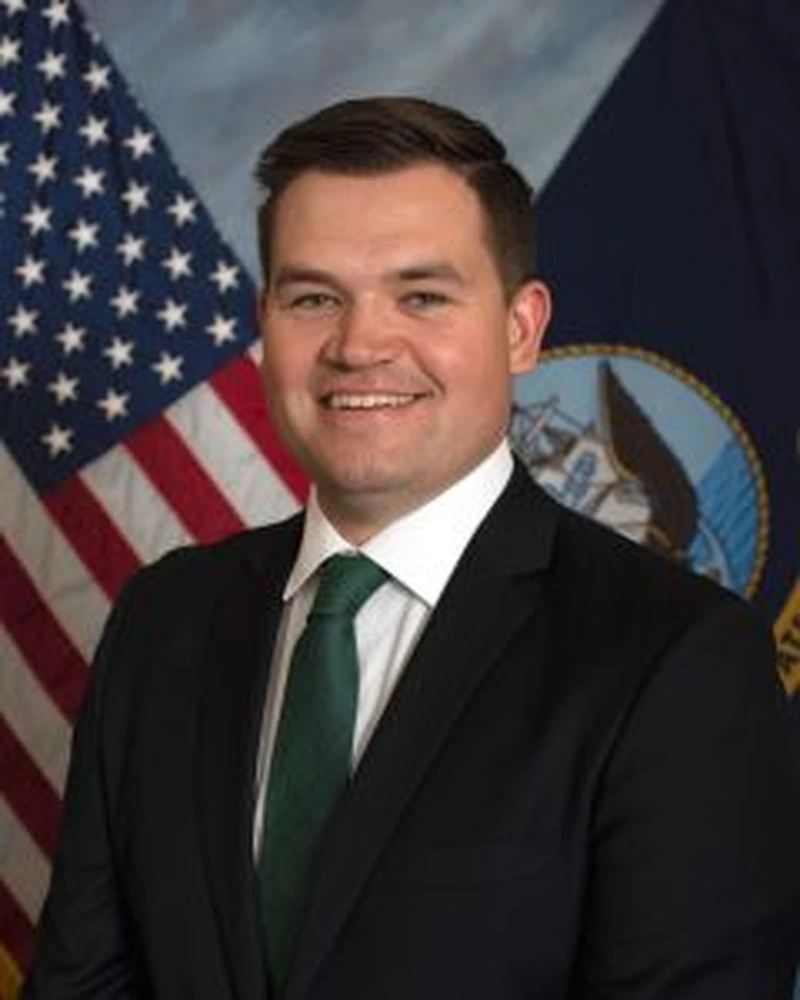
Former U.S. Naval officer and aviator with national-security and legislative experience. Peterman has described service as a naval aviator, Senate defense fellow, and mentor at the U.S. Naval Academy.
Open the interactive Ryan Peterman profile, media archive and Iowa Hogwash Meter reviews →
Public record and background
- More than a decade of military service.
- Worked on defense policy in the U.S. Senate.
- Campaign focus includes election administration, security, access, and public trust.
Documented achievements and notable work
- {'title': 'U.S. Navy service', 'detail': 'A former Naval officer and helicopter pilot whose biography includes more than a decade of military service.', 'sourceId': 'peterman-dass'}
- {'title': 'National-security work', 'detail': 'His public biography includes defense-policy and national-security work, including experience connected to the U.S. Senate.', 'sourceId': 'peterman-dass'}
- {'title': 'Naval Academy mentoring', 'detail': 'His biography describes work mentoring future officers at the U.S. Naval Academy.', 'sourceId': 'peterman-dass'}
- {'title': 'Election-records oversight campaign', 'detail': 'As a candidate, he has used public-records requests to scrutinize state handling of voter-registration data.', 'sourceId': 'peterman-icd'}
Fairness note
Peterman has challenged Secretary Paul Pate over Iowa voter-data sharing with the U.S. Department of Justice. Pate says his office relied on legal advice and federal assurances. That is a genuine policy and legal dispute, not a simple fact-check.
Primary and supporting sources
- Official campaign website — Campaign
- Iowa Capital Dispatch — voter-data records requests (July 22, 2026) — Independent reporting
- Democratic Association of Secretaries of State — Iowa 2026 candidate biography — Aligned organization / biography
Secretary of State race · election administration · September 23, 2026
Pate and Peterman outline different election-administration priorities; current Iowa voting timetable provides the baseline
Pate position: KCCI reported September 23 that Republican Secretary of State Paul Pate pointed to Iowa's paper ballots, voter ID, pre-election equipment testing and post-election audits as safeguards intended to support confidence in election administration. He also cited faster business filings and anti-fraud protections as office-management priorities and said the office should not be run as a partisan role.
Peterman position: KCCI reported that Democratic challenger Ryan Peterman said he wants to make voting more accessible while retaining security. He proposed longer Election Day voting hours, making Election Day a state holiday and, if longer voting hours are not adopted, allowing county auditors to begin mailing requested absentee ballots before the first day of the current voting window. He also called for website modernization and customer-service improvements and repeated his criticism of Iowa's transfer of voter-registration data to the U.S. Justice Department.
Current Iowa timetable: Current Iowa Secretary of State guidance says regular-election polling places are open from 7:00 a.m. to 8:00 p.m. For the November 3, 2026 general election, absentee voting begins October 14 — 20 days before Election Day — and October 14 is also the first day county auditors may mail requested absentee ballots. Mailed-ballot requests are due by 5:00 p.m. October 19. Those current dates provide context for Peterman's proposal to lengthen hours or move mailing earlier; KCCI's report did not include bill text, a fiscal estimate or a final implementation mechanism.
Scope and limits: The Secretary of State's own election-security and voting pages document the practices Pate described, but those office materials are primary-source descriptions of current administration rather than an independent measure of election-system quality. Peterman's proposals are campaign positions, not enacted changes. IA Fact Check records both candidates' stated priorities without treating either side's policy judgment as an established factual conclusion.
KCCI — Iowa Secretary of State candidates discuss election integrity and accessibility (Sept. 23, 2026) · Iowa Secretary of State — absentee voting guidance · Iowa Secretary of State — 2026 general-election voting timeline (Sept. 15, 2026) · Iowa Secretary of State — regular-election polling hours
Record note: This entry documents current policy positions and the existing voting timetable. It does not score candidates, endorse a policy or predict the election.
Election administration · Polk County · September 9, 2026
Polk County sets aside about 1,500 voter-registration challenges until after the November election; the hearing did not remove those voters
What happened: KCCI reports that challenges involving about 1,500 Polk County voter registrations were set aside at a September 9 hearing until after the November 3 general election. Polk County Auditor Jamie Fitzgerald said no one was removed at the hearing and that the challenged registrations would not be removed before the election on the basis of those proceedings.
What this does and does not prove: A challenge filing is an allegation about a registration record, not proof that the voter is ineligible or has voted illegally. The decision to postpone the challenges likewise does not establish that every challenged registration is current and correct; it means the county did not resolve those challenges by removing registrations before the election.
Voting-access context: Iowa Secretary of State guidance confirms that an eligible Iowa resident may register and vote on Election Day after proving identity and residence. The Secretary of State also says a voter challenged at the polls can be offered a provisional ballot, with the ballot reviewed through the statutory process.
IA Fact Check assessment: Documented county election-administration action. Claims that “1,500 illegal voters were found” would overstate the record; KCCI reports roughly 1,500 challenges, not 1,500 adjudicated ineligible voters. Claims that the hearing itself removed the challenged voters are also contradicted by the county auditor’s reported statement that no one was removed and the matters were set aside until after the election.
KCCI — Sept. 9 Polk County challenge hearing · Iowa Secretary of State — Election Day registration · Iowa Secretary of State — voter ID / provisional-ballot FAQ
Secretary of State · campaign-finance claim · September 6, 2026
Peterman’s 2025 fundraising lead is independently supported; the “all-time pre-election-year record” label is a campaign historical comparison, not a state-certified record book
The claim: Ryan Peterman’s campaign said it raised more than $200,000 in 2025 and described that total as a record for an Iowa Secretary of State candidate in the year before the election. The campaign also said the amount already exceeded what incumbent Paul Pate raised during his entire 2022 campaign.
What independent reporting confirms: Iowa Capital Dispatch, using state campaign-finance filings, reported Peterman raised $200,784 during 2025 while Pate raised $62,104. That independently supports the core 2025 dollar total and the large fundraising advantage over Pate during the same reporting period.
The lead continued: In July, Iowa Capital Dispatch reported Peterman raised more than $51,200 during the latest filing period and had more than $166,000 cash on hand, while Pate raised $2,110 and had more than $90,000 cash on hand. That means the challenger’s fundraising lead was not limited to the initial January release.
What remains less independently settled: The “no previous Iowa Secretary of State candidate in history” superlative comes from the Peterman campaign’s review of available campaign-finance records. IA Fact Check did not locate a Secretary of State or Ethics Board publication maintaining a certified all-time leaderboard for this specific pre-election-year metric. Nor does fundraising establish voter support at the ballot box.
IA Fact Check assessment: Core fundraising totals supported; historical superlative needs sourcing context. The $200,784 2025 figure and Peterman’s substantial lead over Pate are independently documented. The broader all-time record characterization is plausible based on the campaign’s records comparison but should be attributed to the campaign unless an official historical series is produced.
Iowa Capital Dispatch — Jan. 23 statewide campaign-finance filings · Iowa Capital Dispatch — July 21 midterm fundraising update · Peterman campaign release as republished by River Cities’ Reader — record claim
Secretary of State race · election administration · September 6, 2026
Federal appeals ruling changes the legal context around Iowa’s planned expanded SAVE voter-citizenship checks
The fresh development: On September 5, the U.S. Court of Appeals for the D.C. Circuit, by a 2-1 vote, declined to lift a nationwide judgment blocking the federal government’s modified SAVE system for voter-roll citizenship checks while the appeal proceeds. Reuters reports the blocked modifications include expanded use of Social Security data and bulk searches, and that the majority cited statutory, privacy and accuracy concerns.
Why this matters in Iowa: Iowa previously negotiated long-term access to SAVE and participation in a pilot for bulk uploads that could include Social Security numbers. In August, Secretary Paul Pate said a 2026 repeat of Iowa’s 2024 “potential noncitizen” challenge list was unlikely because Iowa now had SAVE access and had already worked through the prior list. The September appellate order materially complicates any assumption that the modified bulk-search system will be available as planned for the 2026 general election.
What the Iowa record already showed: Pate’s office said in March 2025 that after obtaining SAVE access it reduced the 2024 list of roughly 2,176 potentially noncitizen registrants to 277 people it described as confirmed noncitizens, including 35 whose ballots were counted. Those Iowa figures are a separate historical claim and are not invalidated merely because a later federal court blocked the modified nationwide SAVE architecture.
IA Fact Check assessment: Changed legal context, not a retroactive falsehood. Pate accurately described Iowa as having negotiated SAVE access when he spoke in August. But the September 5 appellate decision means statements implying Iowa can now rely on the modified bulk SAVE system without legal interruption are no longer current. The system’s availability and scope remain subject to ongoing federal litigation.
Peterman context: Democratic challenger Ryan Peterman has criticized Pate over election-data handling and federal sharing. The new ruling strengthens the relevance of privacy and statutory questions around federal voter-data systems, but it does not by itself prove every separate Peterman allegation about Iowa’s DOJ data transfer or Pate’s administration.
Limits: The D.C. Circuit action is an appellate stay ruling while litigation continues, not a final Supreme Court judgment. A separate Florida proceeding previously created conflicting directions over access for Iowa and several other states. This update does not predict the final outcome or tell county auditors to change any current election procedure.
Reuters — Sept. 5 D.C. Circuit SAVE ruling · Iowa Secretary of State — SAVE settlement and bulk-upload pilot · Iowa Capital Dispatch — Pate’s Aug. 17 remarks · Iowa Secretary of State — March 2025 SAVE audit figures · League of Women Voters — litigation docket/context
Election administration · September 5, 2026
Linn County mass voter-registration challenges: many records were outdated, but the county auditor says that is not evidence of widespread voter fraud
What the local record shows: KCRG reported that more than 495 Linn County registrations were challenged and that roughly 85% of the challenges were accepted. Of the challenged list, 409 registrations involved people found no longer to reside in Iowa. Only three challenged voters appeared to contest their cases at the hearing.
What that does not establish: Acceptance of a registration challenge is not the same thing as proving that an ineligible person cast a ballot. Linn County Auditor Todd Taylor told KCRG that the challenged records would have been caught through the county’s ordinary voter-roll maintenance process and said the episode should not be presented as evidence of widespread voter fraud.
Political context: The challenge list was not limited to one party: KCRG’s review found about 38% of the challenged voters were Democrats, 29% Republicans and 30% no-party voters. Johnson County’s auditor separately told KCRG that roughly 1,000 challenges were filed there in both 2024 and 2025. KCRG asked Secretary of State Paul Pate about the increase and the message it sends about election integrity; the story says he did not respond.
IA Fact Check assessment: Documented election-administration context. The challenged records show that voter files can become stale when people move or otherwise become ineligible at an old address. They do not, by themselves, document illegal voting. Iowa’s Secretary of State confirms that Iowa residency is a qualification for voter registration, so a person who moves out of state should not remain registered at the former Iowa address.
KCRG — Linn County voter challenges and auditor interview · Iowa Secretary of State — voter-registration qualifications